




XML Sitemaps in HighLevel: How to Get Pages Indexed the Right Way
XML sitemaps are one of the most misunderstood—and most misused—parts of SEO inside HighLevel. Almost every HighLevel user knows where sitemaps live, but very few understand how Google actually uses them, or how sitemap mistakes quietly prevent pages from ever ranking.
If you’re building service pages, location pages, or expanding a Local SEO footprint inside HighLevel, sitemap management isn’t optional. It’s foundational.
Let’s clear up what matters, what doesn’t, and how to use XML sitemaps the right way inside HighLevel.
What an XML Sitemap Actually Does (and What It Doesn’t)
An XML sitemap does one primary job:
👉 It helps Google discover, crawl, and index your pages.
That’s it.
A sitemap does not:
Improve rankings by itself
Add authority
Override bad content or structure
Fix orphaned pages
Compensate for poor internal linking
What it does do is eliminate discovery problems—especially common in HighLevel, where pages are frequently added, duplicated, or rebuilt.
If Google doesn’t reliably discover a page, it cannot rank. Period.
Why Sitemaps Matter More in HighLevel Than Most Platforms
HighLevel makes it incredibly easy to spin up pages quickly—but that speed comes with tradeoffs.
Common HighLevel scenarios where sitemaps become critical:
Adding multiple geo-targeted service pages
Duplicating pages as templates
Expanding into new cities or service areas
Replacing blog-based strategies with page-based ones
Launching new funnels alongside websites
Unlike WordPress or traditional CMS platforms, HighLevel does not automatically manage sitemap updates in a way Google reliably reprocesses. That’s where most users get stuck.
Pages exist. Pages look fine. Pages never rank.
Nine times out of ten, discovery is the issue.
Sitemap Control = Crawl Control
One of the biggest advantages of HighLevel’s sitemap system—when used correctly—is intentional control.
Inside HighLevel, you decide:
Which pages are included
Which pages are excluded
When Google is notified of changes
That control matters because HighLevel can generate pages you do not want indexed:
Funnel steps
Thank-you pages
Template pages
Test pages
Utility pages
Submitting a messy sitemap wastes crawl budget and muddies Google’s understanding of what actually matters on your site.
A clean sitemap is a focused sitemap.
The Most Common Sitemap Mistake HighLevel Users Make
Here’s the mistake I see constantly:
“I added new pages, so I just resubmitted my sitemap in Search Console.”
That’s not enough.
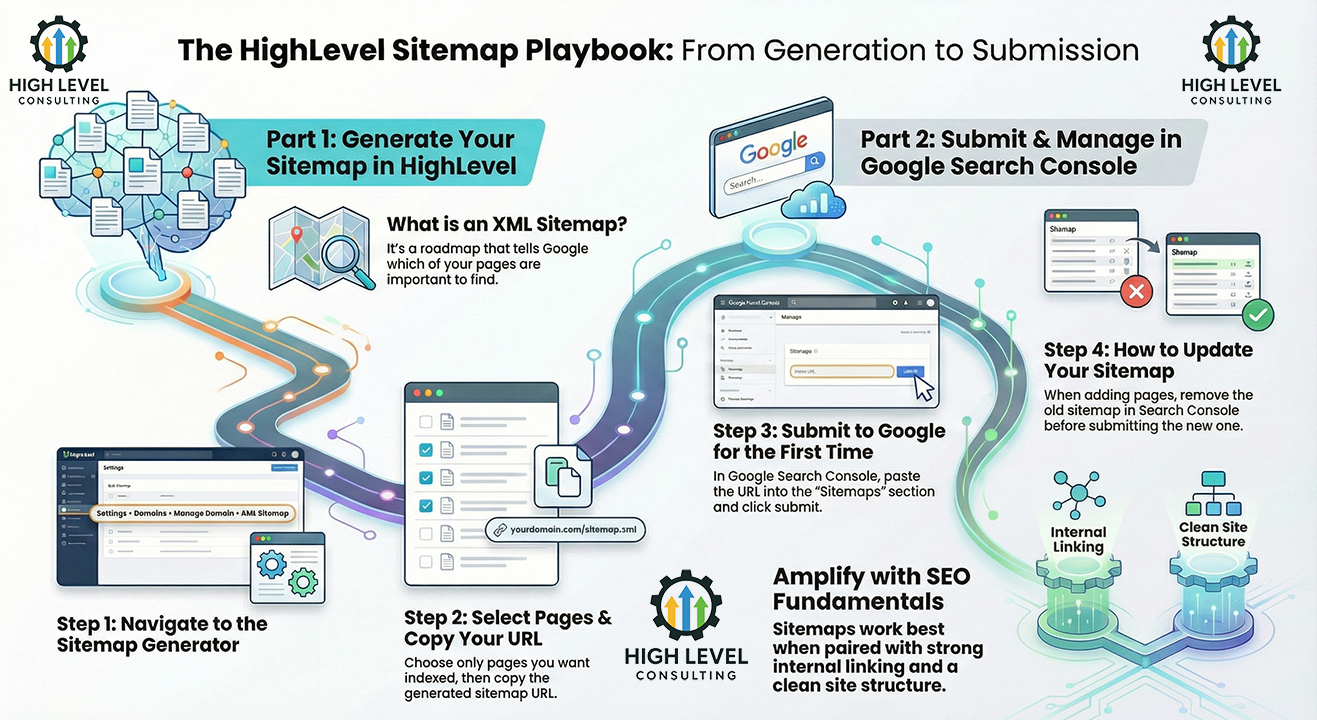
When you add new pages in HighLevel, the correct process is:
Generate a new sitemap in HighLevel
Remove the existing sitemap in Google Search Console
Submit the new sitemap as if it were brand new
Why?
Because Google often caches sitemap data. Simply resubmitting does not guarantee full reprocessing. Removing the sitemap forces Google to treat the new file as authoritative and re-evaluate every URL listed.
If you skip this step, new pages may:
Take weeks to index
Never index
Be inconsistently crawled
This is especially important for Local SEO pages where timing matters.
How Sitemaps Fit Into a Real Local SEO Strategy
Sitemaps are not the strategy—they support the strategy.
They work best when paired with:
Strong internal linking (no orphan pages)
Clear site structure
URL inspection requests for priority pages
Google Business Profile activity
Off-page signals that reinforce relevance
Think of the sitemap as your official declaration to Google:
“These are the pages that matter right now.”
Everything else reinforces that message.
Why This Matters for Local SEO Results
Local SEO success inside HighLevel depends on execution, not tools.
You can build the best service page in the world—but if Google never reliably processes it, it doesn’t exist.
Mastering sitemap management closes the gap between:
Page creation
Page discovery
Page evaluation
That gap is where most HighLevel Local SEO campaigns quietly fail.
Want the Full Local SEO Playbook for HighLevel?
Sitemaps are just one piece of the system—but they’re a critical one.
If you want to learn how Local SEO actually works inside HighLevel—from page structure, to geo-expansion, to indexing, to off-page reinforcement—you can find the full breakdown here:
👉 https://highlevel.consulting/seo-for-high-level
That’s where I go deep on the workflows that consistently produce rankings—not theory, not templates, and not guesswork.