



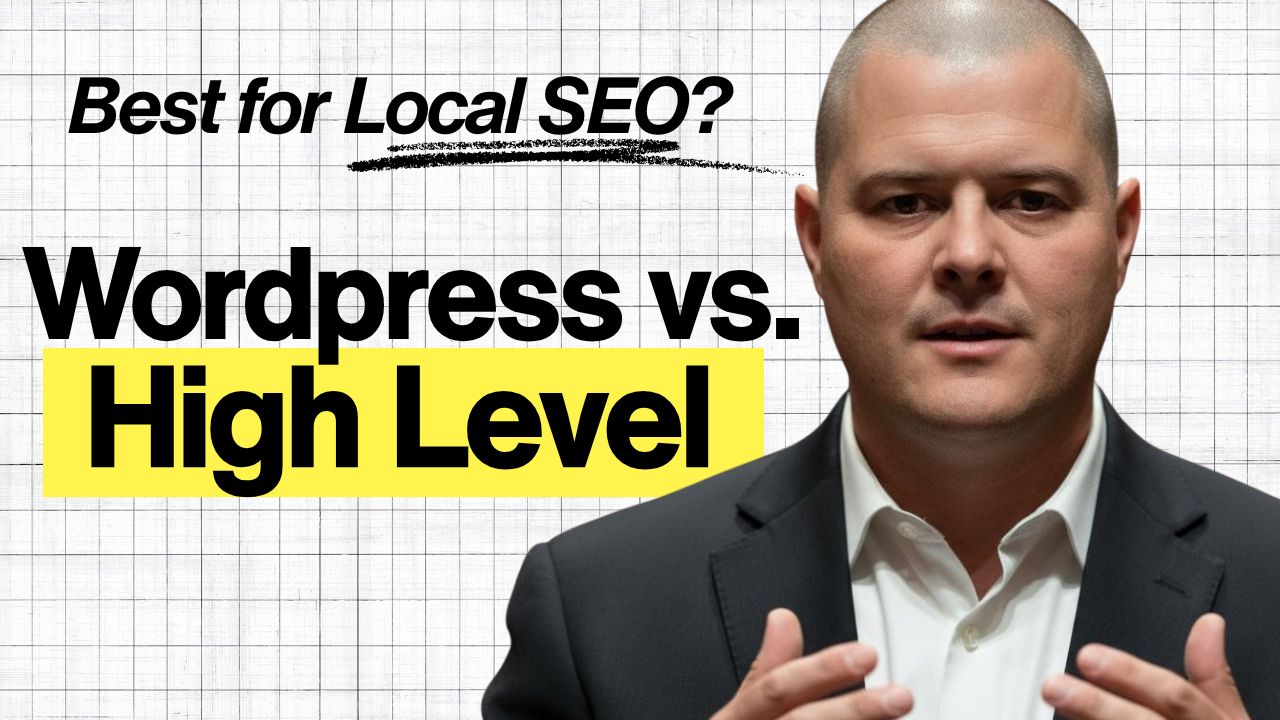
WordPress vs HighLevel for Local SEO: A Practical Framework for Agencies

The ongoing debate between WordPress and HighLevel isn’t really about which platform is “better.” It’s about priorities. Specifically, it’s about whether an agency is optimizing for maximum technical SEO control or for scalable business operations. Both platforms are strong. Both are flawed. And most of the disagreement comes from evaluating them against the wrong objective.
For local businesses, and the agencies that serve them, the correct question is not “Which CMS ranks better?” It’s “Which system best supports consistent visibility in the Google Maps Pack while aligning with how the agency actually operates and makes money?”
Once that question is answered honestly, the platform decision becomes much clearer.
The Real Goal of Local SEO Isn’t Website Rankings
A common mistake in this discussion is treating local SEO like traditional organic SEO. In reality, most local businesses do not win or lose based on blog content depth, schema complexity, or pixel-perfect technical execution. They win or lose based on whether they appear in the Google Maps Pack for high-intent searches.
In that environment, the website plays a supporting role. Its job is to reinforce relevance, location trust, and entity consistency. The heavy lifting happens elsewhere.
Google evaluates a blended set of signals when determining Maps Pack visibility, including Google Business Profile optimization, proximity, reviews, citations, engagement data, and local authority. On-page SEO still matters, but it is rarely the deciding factor once basic relevance thresholds are met.
This distinction introduces an important concept: ranking efficiency versus ranking capability. Some platforms make SEO tasks faster and easier. Others are simply capable of supporting the signals Google values when paired with the right strategy. Confusing those two ideas is where most arguments begin.
Why WordPress Is Still the SEO Benchmark
When the discussion is limited strictly to SEO execution, WordPress remains the benchmark.
Its plugin ecosystem dramatically reduces friction for SEO practitioners. Tasks like schema management, internal linking, analytics integration, and programmatic page creation can be handled quickly and at scale. On a well-managed hosting environment, WordPress also provides deep technical control over performance, caching, databases, and Core Web Vitals.
Modern WordPress page builders produce cleaner site architecture and give SEOs precise control over navigation, content silos, and internal linking. Combined with faster iteration cycles, this makes WordPress the most efficient environment for executing advanced SEO strategies, particularly in competitive markets.
From a pure optimization standpoint, this advantage is real and undeniable.
The Business Cost of a WordPress-First Model
That technical superiority comes with tradeoffs, especially for agencies managing many clients.
WordPress is the most targeted CMS in the world, which means security, updates, compatibility testing, and maintenance never stop. These responsibilities often fall on the agency and consume non-billable time. Plugin sprawl can introduce instability and performance issues over time if not tightly managed.
There is also a commoditization problem. Because WordPress talent is everywhere, websites are easy to replace. Once a site is delivered, clients can move it to another developer or agency with minimal friction. Retention then depends entirely on ongoing services rather than platform leverage.
None of this makes WordPress a bad choice. It simply means agencies must be intentional about whether they want to absorb that operational burden in exchange for SEO flexibility.
What HighLevel Optimizes For Instead
HighLevel was not designed to win a technical SEO comparison. It was built to consolidate systems.
HighLevel brings websites, CRM, automations, messaging, call tracking, attribution, and reporting into a single environment. That consolidation reduces tool sprawl, simplifies onboarding, and changes the agency-client relationship. The website becomes part of a revenue system rather than a standalone asset.
This integration creates real advantages for local SEO execution, even if they don’t look like traditional SEO wins. Review generation workflows are native and automated. Google Business Profile posts can be scheduled and managed consistently. Engagement signals from forms, calls, chats, and follow-ups are tightly connected to customer records and pipelines.
These systems influence some of the most heavily weighted local ranking signals, and they are notoriously difficult to systematize in a modular WordPress stack without multiple third-party tools.
Understanding Control vs Constraint
The most productive way to compare these platforms is to look at what each one gives you direct control over.
WordPress gives agencies control over the website itself: code output, performance tuning, schema depth, sitemaps, crawl directives, and internal linking logic. If technical precision is the primary value being sold, that control matters.
HighLevel gives agencies control over execution outside the website: reviews, Google Business Profile activity, engagement workflows, lead follow-up, and operational consistency across accounts. These systems heavily influence local rankings, particularly in the Maps Pack.
HighLevel does limit advanced technical SEO controls. Agencies using it must compensate by leaning more heavily into authority, relevance, and engagement signals. That is not a weakness if the strategy is designed accordingly. It becomes a problem only when agencies attempt to force WordPress-style workflows into a platform built for a different purpose.
Is HighLevel “Good Enough” for Local SEO?
For most local markets, the answer is yes—when used correctly.
In low-competition environments, solid on-page fundamentals combined with consistent Google Business Profile activity and review velocity are often enough to dominate. In mid-competition markets, disciplined off-page execution becomes critical, regardless of platform. In highly competitive markets, WordPress can offer advantages, but even there, authority and trust signals often outweigh CMS-level differences.
HighLevel does not need to outperform WordPress technically to be viable. It needs to meet the relevance threshold while enabling agencies to execute off-page strategies consistently and at scale. Many agencies fail here not because of platform limitations, but because they underutilize the systems HighLevel provides.
Choosing a Stack That Matches Your Agency Model
The right platform choice depends on how the agency delivers value.
SEO-first agencies tend to favor WordPress because rankings themselves are the product. Automation-first agencies gravitate toward HighLevel because retention, attribution, and operational leverage matter more than marginal SEO gains. Hybrid agencies intentionally use both, deploying WordPress as an authority layer and HighLevel as the conversion and operations layer.
The mistake is treating this as a binary decision or assuming one platform universally dominates the other.
Final Perspective
WordPress wins the technical SEO argument. HighLevel wins the operational argument.
Agencies that understand both truths and align their platform choice with their business model put themselves in the strongest position to succeed. The real advantage does not come from the tool itself, but from knowing what to control, what to compensate for, and how to execute consistently in the environments that matter most for local search.
That strategic clarity—not platform loyalty—is what separates agencies that struggle with local SEO from those that scale it successfully.