




Working Against the Grain: Why Some Industries Are a Poor Fit for SEO
The Question That Comes Up Constantly
This conversation almost always starts the same way. Someone reaches out with what sounds like a technical question—“Can you rank a site built in HighLevel, or does it need to be rebuilt in WordPress?” On the surface, it looks like a platform debate. Underneath it, though, is a much more important concern: “Do you actually know how to rank sites in competitive environments?”
In most cases, the person asking isn’t truly worried about content management systems, page builders, or hosting environments. They’re trying to assess risk. Rebuilding a website is expensive, time-consuming, and disruptive, and they want reassurance that the site they already have isn’t a liability. The platform question becomes a proxy for trust. If you can confidently explain how rankings are achieved regardless of tooling, you pass the first test.
What tends to surprise people is when the answer isn’t about the platform at all. Whether a site is built in HighLevel, WordPress, Duda, Joomla, SquareSpace (avoid), Wix (avoid), Webflow, or anything else is rarely the limiting factor. The real constraint is almost always the industry itself—how competitive it is, how much control the business has over its digital assets, and whether the economics of SEO actually make sense in that niche.
That’s where disappointment sometimes creeps in. When the conversation shifts from “Yes, I can rank that platform” to “I don’t work in that industry,” it can feel abrupt or confusing. To the business owner, it may sound like avoidance or lack of confidence. In reality, it’s usually the opposite. It’s the result of having seen the same structural problems play out repeatedly across certain verticals, regardless of how good the SEO execution is.
This article exists to explain that distinction. Not every industry is a good fit for SEO—not because SEO doesn’t work, and not because the platforms are inadequate, but because the rules of the game make sustainable, profitable outcomes extremely difficult. Understanding that difference upfront saves everyone time, money, and frustration.
SEO Is Not Industry-Agnostic
One of the most persistent myths in digital marketing is that SEO works the same way in every industry. The thinking goes like this: if you understand on-page optimization, technical SEO, content strategy, and link building well enough, you should be able to apply that formula anywhere and expect roughly similar outcomes. In practice, that assumption breaks down very quickly.
SEO is not just a technical discipline—it is an economic one. Search results are shaped by competition, incentives, and constraints long before tools or tactics ever enter the picture. Two businesses can follow identical best practices and see wildly different results simply because the industries they operate in play by very different rules. The question isn’t whether SEO can work; it’s whether it can work efficiently enough to justify the investment.
Some industries are structurally friendly to organic growth. They allow full control over websites, content, messaging, internal linking, and conversion paths. They have room for deep, differentiated content and clear topical authority. Others are structurally hostile. They impose compliance restrictions, template-driven pages, brand guidelines, and approval processes that limit how much meaningful differentiation is possible. No amount of technical skill can fully overcome those constraints.
This is where the difference between possible and economically viable SEO matters. Yes, it is technically possible for almost any business to rank for something. The more important question is how much time, money, and effort it will take to get there—and whether the return justifies that cost. In highly saturated industries with limited flexibility, the cost curve rises sharply while the upside remains capped.
Experienced SEOs learn this lesson the hard way. After enough campaigns that stall despite clean execution, you start to see patterns. Certain verticals consistently require outsized effort just to achieve marginal gains, while others compound quickly with far less friction. Over time, this leads to specialization—not because SEOs lack capability, but because they understand where their work produces real leverage.
This is why industry selection matters as much as strategy. SEO is not a universal lever you pull the same way for every business. It is a discipline that rewards alignment between competition, control, budget, and expectations. When those elements are misaligned, even “perfect” SEO struggles to move the needle in a meaningful way.
Industries That Are Captive by Design
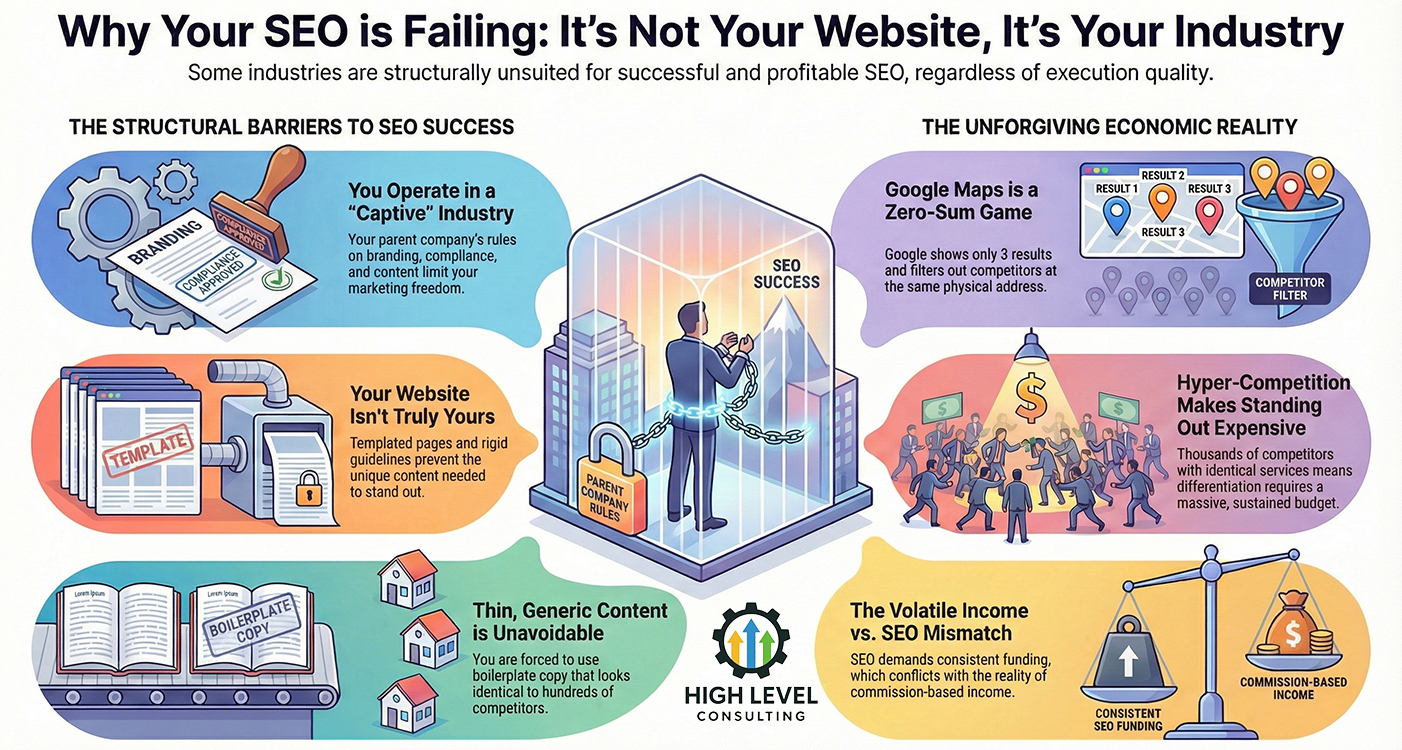
Some industries don’t just happen to be competitive—they are structurally constrained in ways that make organic visibility an uphill battle from day one. These are what I refer to as captive industries. The businesses operating within them are not fully independent when it comes to branding, messaging, content, or even how they present themselves online.
Real estate is a perfect example. Most agents operate under a brokerage, which means they are bound by brand standards, legal language, and predefined marketing structures. Even when an agent is highly motivated and willing to invest, they often don’t have final authority over what can be published, how pages are structured, or how aggressively they can differentiate themselves from other agents in the same office. The same pattern shows up with insurance agents under carriers and financial advisors under large firms or compliance-heavy groups.
From an SEO perspective, this lack of control is critical. Organic search rewards clarity, depth, differentiation, and authority. Captive industries limit all four. Messaging has to be approved. Claims must be carefully worded. Content often follows templated language designed to reduce legal risk, not to establish topical authority. What’s left is safe, generic copy that looks nearly identical across dozens—or hundreds—of competing profiles.
In many cases, the primary web presence isn’t even a standalone website. It’s a profile page living on a larger corporate domain. On paper, that can sound appealing because the parent site may have strong domain authority. In practice, those pages are usually thin, rigid, and isolated. There’s little room for internal linking strategies, media expansion, schema customization, or conversion optimization. You’re essentially trying to rank a business using a page you don’t truly own.
Even when someone in a captive industry does have their own website, the constraints don’t disappear. Brand guidelines, compliance requirements, and brokerage rules still dictate what can be said and how it can be said. That dramatically narrows the range of keywords you can target and the stories you’re allowed to tell. SEO becomes an exercise in incremental gains rather than meaningful differentiation.
This is the core challenge with captive industries: they strip away leverage. SEO thrives when businesses can fully control their assets and shape their narrative. When that control is fragmented or outsourced to a larger entity, even excellent execution runs into a ceiling that skill alone cannot break through.
The Thin Content Problem
Thin content is one of the most common—and least fixable—problems in the industries discussed here. In theory, content depth is something that can always be improved. In reality, many businesses simply aren’t allowed to improve it in any meaningful way.
For real estate agents operating under a brokerage, the primary digital asset is often a single profile page on the brokerage’s website. That page may include a short bio, a headshot, contact information, and a handful of boilerplate paragraphs about buying or selling homes. From an SEO standpoint, this is an incredibly weak foundation. There is no room for long-form content, supporting subpages, internal topical clusters, or nuanced local relevance. You are trying to compete in one of the most competitive local niches in existence with a page that barely scratches the surface of user intent.
Control is the real issue. Even when agents recognize that their page is thin, they usually can’t fix it. Page layouts are locked. Navigation is fixed. Internal links are predetermined. Schema markup is either nonexistent or globally applied with no customization. Media assets are restricted. Calls to action are standardized. The page exists to satisfy corporate branding requirements, not to win competitive search results.
Standalone websites don’t always solve this problem. Compliance rules and brand oversight often limit how much original, opinionated, or educational content can be published. That leads to the same generic blog posts and service pages being repeated across hundreds of sites with minor wording changes. From Google’s perspective, there is very little to distinguish one from another. From a user’s perspective, the experience is equally interchangeable.
Search engines reward usefulness and specificity. Thin content—especially when it is templated or duplicated—signals the opposite. It tells Google that the page exists because it has to, not because it meaningfully serves a unique audience. In densely populated industries, that distinction matters even more. When everyone is competing for the same keywords with nearly identical pages, the algorithm has no reason to favor most of them.
This is why thin content isn’t just a content problem—it’s a structural one. If a business cannot expand, deepen, and differentiate its on-page assets, SEO becomes an exercise in pushing against a wall. You can optimize what exists, but optimization alone cannot compensate for the absence of substance.
Even With a Standalone Website, the Math Is Brutal
It’s tempting to assume that the solution to all of this is simple: “Just build your own website.” And while having a standalone site is absolutely better than being confined to a single profile page on a corporate domain, it does not magically fix the underlying problem in these industries. The competitive math remains unforgiving.
Real estate, insurance, and financial services are among the most densely populated niches in local search. In a mid-sized city, there may be hundreds of agents targeting the same handful of keywords. In major metro areas, that number can easily climb into the thousands. Most of them offer nearly identical services, operate in the same neighborhoods, and target the same buyer or seller intent. From Google’s perspective, the difference between them is often marginal.
That density creates a severe differentiation problem. SEO works best when you can clearly signal why one business deserves visibility over another. In these industries, the allowed differences are minimal. You can’t dramatically change service offerings. You can’t make bold claims. You can’t meaningfully reposition yourself without running into compliance or brand restrictions. The result is a sea of websites that look different visually but say the same thing in substance.
Content volume alone doesn’t solve this. Publishing more pages in a hyper-competitive niche simply increases the cost of participation. Every new page has to be better than what already exists, not just technically sound. That requires research, writing, editing, and ongoing maintenance—multiplied across dozens of keywords and locations. The time and budget required scale quickly, while the incremental gains shrink.
This is where the economics of SEO become impossible to ignore. To outrank entrenched competitors in a saturated market, you need sustained effort across on-page, technical, and off-page signals. That means months or years of consistent investment before meaningful traction appears. For many independent agents, that level of commitment simply isn’t realistic, especially when lead flow is unpredictable and commissions are cyclical.
The harsh reality is that standalone websites remove some constraints, but they don’t change the competitive landscape. The math still favors scale, authority, and differentiation—three things that are exceptionally hard to achieve in industries where everyone is chasing the same visibility with the same limitations.
The Google Maps Reality No One Talks About
This is one of the most important constraints in local SEO—and it’s rarely discussed honestly with agents before work begins. Google’s Maps Pack is not an infinite opportunity space. It is a fixed, highly constrained environment, and the rules that govern it are unforgiving, especially in industries like real estate.
In most local searches, Google displays three results in the Maps Pack. That’s it. Those three spots are influenced by proximity, relevance, and prominence—but proximity plays a much larger role than many people realize. When multiple businesses share the same physical address, Google is not going to reward all of them with visibility. It simply doesn’t make sense from a user experience perspective.
This becomes a major issue in brokerages and business parks. It’s extremely common to have 10, 20, or even more agents operating out of the same office, all with their own Google Business Profiles, all targeting the same city and keywords. Google will not show three results from the same address. In many cases, it won’t even show two. What happens instead is proximity filtering: one profile survives, and the rest are filtered out—even if they are fully optimized and have strong reviews.
Now layer in the reality of business parks. If there are two or three brokerages located in the same complex, you might end up with one agent from one brokerage and one from another making it into the Maps Pack. Everyone else—sometimes dozens of agents—is competing for visibility that simply does not exist. This isn’t a quality issue. It’s a physical limitation imposed by how Google interprets local intent.
This creates a zero-sum game with a built-in ceiling. No amount of on-page optimization, posting, or review solicitation can overcome the fact that Google is not going to show 15 agents at the same address for the same query. Someone has to lose, and statistically, most people will. That’s not pessimism—it’s math.
For an SEO, this is a critical consideration. When a client’s primary visibility goal is Maps-based traffic, and they are physically clustered with many identical competitors, the odds are stacked against them before any work begins. Ignoring that reality leads to false expectations, wasted budget, and frustration on both sides. Understanding it upfront is one of the reasons experienced SEOs are cautious about these industries.
Differentiation Is Mandatory—And Expensive
In industries like real estate, ranking is not about doing some things right—it’s about doing everything right, consistently, and for a long time. When competition is this dense and structural constraints are this tight, differentiation isn’t optional. It’s the minimum requirement just to stay in the conversation.
From an on-page perspective, that means more than clean titles and headings. It requires perfectly structured pages that satisfy search intent better than dozens or hundreds of alternatives. Content has to be genuinely useful, locally relevant, and written for humans first—while still being clear and unambiguous to search engines. In highly regulated industries, achieving that balance often takes multiple revisions, approvals, and compromises, all of which increase cost and slow momentum.
Technical execution has to be equally precise. Advanced schema markup becomes critical, not as a gimmick, but as a way to help search engines understand context in an environment where content is often constrained. Entity relationships, service definitions, geographic signals, and brand clarity all need to be reinforced technically because the content alone rarely carries enough weight.
Off-page signals are where the cost really escalates. In crowded niches, authority is the primary differentiator. That means earning high-quality backlinks, not cheap directory links. It means consistent brand mentions across reputable sources. It means an ongoing, authentic flow of five-star reviews—not a one-time push. It means active social profiles where content is shared, engaged with, and occasionally amplified beyond the business’s immediate audience.
None of this happens accidentally, and none of it happens cheaply. These are not one-off tasks; they are ongoing systems that require strategy, execution, monitoring, and adjustment. When multiplied over months or years, the investment required to compete at a meaningful level becomes substantial.
This is where expectations often collide with reality. Many agents assume SEO is a relatively low-cost alternative to paid advertising. In hyper-competitive, tightly constrained industries, the opposite is true. SEO becomes one of the most expensive channels to do correctly, because the margin for error is so small. Without the budget to sustain that level of effort, differentiation remains theoretical—and rankings remain out of reach.
The Budget Mismatch Problem
This is where most SEO campaigns in these industries quietly fail—not because the strategy is wrong, but because the economics never lined up in the first place. Highly competitive niches demand disproportionately high investment, yet the businesses operating within them are often structured in a way that makes sustained marketing spend difficult.
Most real estate agents, insurance agents, and financial advisors are independent contractors. Their income is commission-based, cyclical, and unpredictable. Marketing budgets fluctuate with the market, deal flow, and personal risk tolerance. That volatility is fundamentally at odds with how SEO works. Organic search rewards consistency over time, not bursts of effort followed by pullbacks.
At the same time, the competition is relentless. You’re not just competing with other solo operators—you’re competing with teams, brokerages, franchises, lead-generation companies, and national platforms that can afford long-term investment. Those entities can weather slow months. They can fund content, links, reviews, and brand building even when short-term ROI isn’t immediately visible.
This creates a mismatch that’s hard to overcome. To compete, you need sustained investment in content, authority, and visibility. To survive financially, many agents need immediate returns. When leads slow down, marketing is often the first thing to be cut, which resets progress and erodes whatever momentum has been built. SEO doesn’t respond well to stop-and-start behavior.
There’s also a perception problem. Because SEO is often sold as a “long-term play,” it’s easy to underestimate the level of commitment required in crowded markets. What works in less competitive industries at a modest budget simply does not translate here. The same spend that produces meaningful gains elsewhere may barely register in these verticals.
For an SEO professional, this creates an ethical and practical dilemma. Taking on work where the required investment is known to exceed what the client is realistically willing or able to spend rarely ends well. Results stall, frustration grows, and the relationship deteriorates. Recognizing that mismatch early is not pessimism—it’s experience.
SEO Alone Is Rarely Enough Here
Even when everything is executed well—clean on-page structure, solid technical foundations, quality content, and a steady stream of authority signals—SEO by itself is rarely sufficient in these industries. The competitive pressure is simply too high, and the visibility bottlenecks are too narrow.
In real estate and similar verticals, search demand is finite and heavily contested. Ranking organically does not guarantee consistent lead flow, especially when user behavior is fragmented across Maps, paid ads, aggregator sites, and referral platforms. Many prospects never reach organic listings at all. They click on ads, marketplace results, or platforms they already recognize and trust.
That’s why successful operators in these spaces almost always rely on multiple acquisition channels. Paid search and Local Service Ads help capture demand that organic results can’t reach quickly enough. Retargeting reinforces brand recognition for users who aren’t ready to convert on the first visit. Offline marketing and referral networks fill gaps that search alone cannot cover.
From an SEO standpoint, this matters because organic traffic often plays a supporting role rather than a primary one. SEO helps build credibility, reinforce brand presence, and capture long-tail intent—but it rarely carries the full weight of lead generation on its own. Treating it as the sole growth engine sets unrealistic expectations.
This multi-channel reality also increases complexity and cost. SEO has to be coordinated with paid media, messaging, and conversion strategy to be effective. That coordination takes planning, data, and ongoing optimization. For many independent agents, managing and funding that ecosystem is not feasible long term.
Understanding this upfront is critical. SEO is powerful, but it is not magic, and it does not operate in a vacuum. In industries where competition is intense and structural limits are real, organic search works best as part of a broader system—not as a standalone solution expected to do everything.
Why Serious SEOs Often Opt Out
By the time an SEO has spent years working across multiple industries, certain patterns become impossible to ignore. Some niches consistently allow momentum to compound, while others absorb time, effort, and budget without producing proportional results. Over time, experienced SEOs stop asking “Can this be ranked?” and start asking “Should this be ranked?”
Opting out of industries like real estate, insurance, or heavily regulated financial services is rarely about capability. It’s about leverage. SEO works best when small improvements create outsized gains. In captive, densely populated industries, the opposite is true. Massive effort is often required just to move the needle slightly—and even then, results can be fragile and easily displaced.
There’s also a client-expectation problem that experienced SEOs learn to avoid. When structural constraints limit outcomes, even good results can feel disappointing. Ranking improvements don’t always translate into consistent leads. Maps visibility fluctuates due to proximity filtering. Algorithm updates reshuffle already crowded SERPs. Clients may interpret these realities as execution failures rather than environmental ones.
From a business perspective, this creates risk on both sides. The SEO invests heavily in strategy and execution, often going beyond the scope of what the budget truly supports. The client invests money and time into a channel that may never become a primary driver of growth. When expectations and outcomes diverge, trust erodes—even if the work itself was solid.
This is why many serious SEOs specialize. They choose industries where control over assets is high, differentiation is possible, and budgets align with competition. Saying “no” to certain verticals is not a lack of ambition—it’s a recognition of where SEO can actually perform as intended.
Walking away from a bad fit is often the most professional recommendation an SEO can make. It protects the client from overinvesting in a channel with limited upside, and it allows the SEO to focus on environments where their work can compound rather than stall.
Who SEO Is a Good Fit For
While some industries are structurally resistant to organic growth, others are naturally aligned with how SEO compounds value over time. The difference isn’t talent, tooling, or effort—it’s control, differentiation, and economic leverage.
SEO performs best for businesses that fully own their digital assets. That means control over website structure, content depth, internal linking, media, schema, and conversion paths. When a business can create pages intentionally—rather than fitting into predefined templates—it can build topical authority instead of just occupying space. That control allows SEO work to stack, rather than reset or plateau.
Industries that reward specialization also tend to be strong fits. When services can be clearly differentiated, explained in depth, and supported with real-world examples, content stops being generic and starts becoming useful. This creates natural long-tail visibility, stronger engagement signals, and clearer relevance for search engines. Over time, these signals compound into authority that competitors struggle to replicate.
Budget alignment matters just as much. SEO works best when businesses understand that it’s a system, not a task. Consistent investment in content, authority, and optimization creates momentum. Industries where owners think in terms of long-term asset building—rather than short-term lead spikes—are far more likely to see meaningful returns.
Local service businesses outside of captive structures often fall into this category. So do niche B2B providers, specialized contractors, professional services with clear positioning, and multi-location operators that can leverage scale without being restricted by corporate compliance. In these environments, SEO becomes a growth engine rather than a constant uphill battle.
The common thread is leverage. When businesses can differentiate, control their narrative, and fund the work required to compete, SEO stops being fragile. It becomes predictable, measurable, and increasingly efficient over time. That’s the environment where serious SEO thrives—and why experienced practitioners gravitate toward it.
Closing Perspective: This Isn’t About Capability
When an SEO declines to work in certain industries, it’s easy to misinterpret that decision as a limitation—either of skill, confidence, or willingness to take on a challenge. In reality, it’s usually the opposite. It’s the result of understanding how search ecosystems actually function and recognizing when the conditions for success simply aren’t there.
SEO is not a checklist, and it’s not a platform debate. It’s a long-term investment that only pays off when competition, control, budget, and expectations are aligned. In industries where those elements are structurally misaligned, even excellent execution can feel like pushing a boulder uphill. Progress is slow, fragile, and expensive, and the upside is often capped by forces outside anyone’s control.
That doesn’t mean businesses in these industries are doing anything wrong. It means the channel may not be the right primary lever for growth. In many cases, other strategies—paid media, partnerships, referrals, or platform-specific visibility—offer clearer paths to ROI with far fewer structural constraints.
For SEOs, choosing where not to operate is as important as choosing where to focus. It allows them to deliver results with integrity, avoid overpromising, and protect clients from investing in strategies that are unlikely to compound. Saying “no” is sometimes the most honest form of expertise.
Understanding this distinction reframes the original question entirely. The issue isn’t whether a website is built in HighLevel or WordPress. The real question is whether the environment supports sustainable SEO success at all. When it does, platform choice becomes secondary. When it doesn’t, no platform can fix the problem.
Want to know if you're a good fit?
If you’re considering SEO and want an honest assessment of whether it makes sense for your industry, competition, and goals, that’s a conversation worth having before time and budget are committed. We’re upfront about what SEO can and can’t realistically deliver—and where it has the best chance to compound.
If you want clarity instead of guesswork, start here:
https://highlevel.consulting/hire-us-to-help
We’ll help you determine whether SEO is the right lever—or if your growth is better served elsewhere.