




Technical SEO in High Level Websites
The HighLevel SEO Secret: It's About Discipline, Not Difficulty
If you've ever felt frustrated trying to optimize a HighLevel website for search, you're not alone. The common perception is that without server-level access, true technical SEO is out of reach. This feeling of limitation leads many to neglect the technical fundamentals entirely.
The surprising truth, however, is that successful technical SEO on a SaaS platform isn't about complex engineering. It’s about mastering the powerful controls you do have. We'll reveal the simple site-wide toggles that boost performance, the non-negotiable rules of page structure, and the validation habits that turn confusing code into a competitive advantage.
The Two Toggles That Solve Most Performance Issues
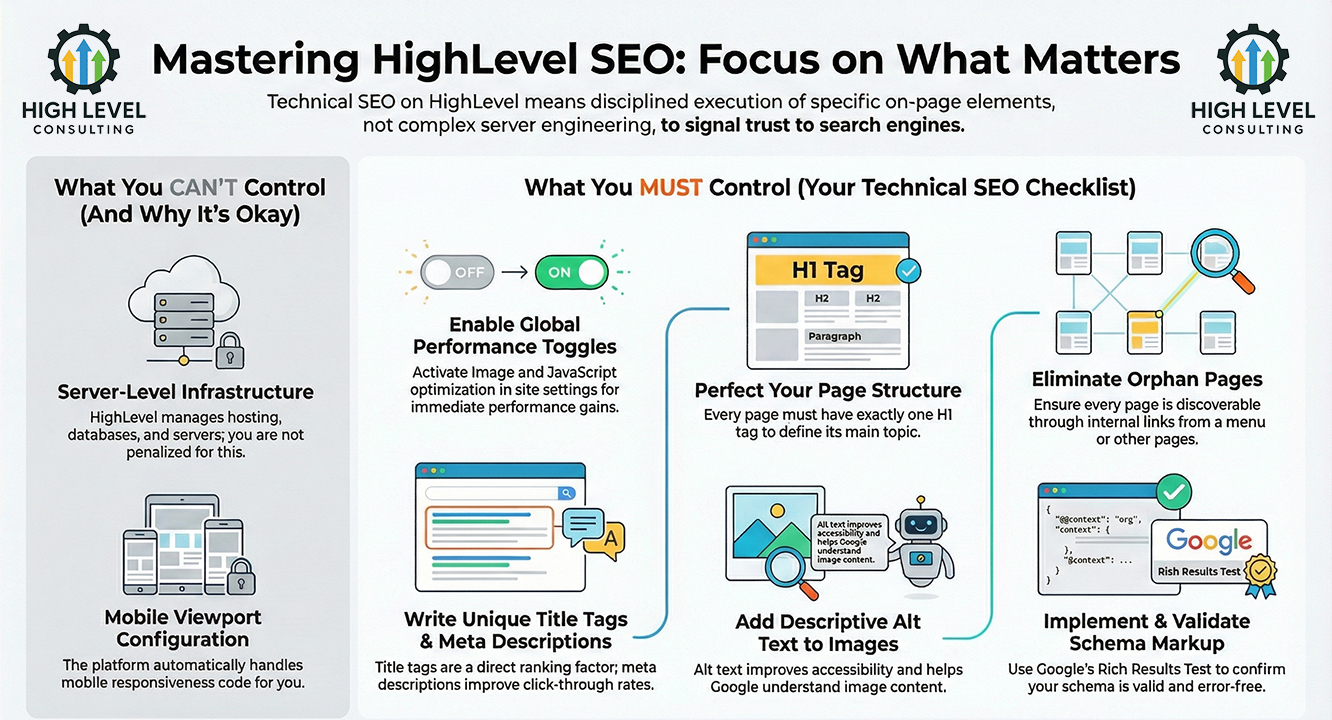
Before diving into page-level details, let's start with the easiest and most impactful wins available to you. Inside HighLevel's Website Settings, there are two global performance toggles that should always be enabled:
Image Optimization: This ensures your images are automatically compressed and served efficiently, reducing page weight and dramatically improving load times.
JavaScript Optimization: This setting improves how scripts are handled, reducing unnecessary rendering delays that can frustrate both users and search engine crawlers.
According to our analysis, enabling these two settings alone addresses a large percentage of performance-related technical issues. This is the first and most powerful proof of our central theme: you have tangible controls that matter.
Stop Worrying About the Server—Google Already Has
It's a counter-intuitive but liberating fact: Google does not penalize your website for lacking access to low-level infrastructure. The search engine understands the constraints of SaaS platforms and knows you cannot adjust CPU allocation, tune database queries, or modify server-side caching layers.
HighLevel handles many technical details for you automatically, like ensuring the proper viewport meta tag is in place for mobile responsiveness. Realizing this allows you to stop worrying about the elements you can't touch and focus all your energy on the ones that directly impact your performance—the crawl, structure, and clarity issues that weaken your search signals.
It’s About Discipline, Not Advanced Engineering
The vast majority of technical SEO problems found on HighLevel websites are not complex algorithmic challenges; they are simple "unforced errors." These are fundamental mistakes that are entirely within your control to fix, including common issues like:
Missing tags
Broken page structure
Orphaned pages
Invalid schema
These errors pile up not because the work is difficult, but because it requires a consistent, detail-oriented process.
Technical SEO on this platform is not about advanced engineering—it is about discipline.
This shifts the entire dynamic of technical SEO. You don’t need a developer to fix these problems—you need a clear checklist and the discipline to apply it consistently across your site.
A Page's Blueprint: Titles, Headers, and Structure
Every page on your site has a structural blueprint that tells Google what it's about. Getting this wrong is a common and critical unforced error.
First, every page must have a unique title tag that clearly reflects its purpose. Title tags are direct ranking signals and are one of the most important on-page elements you control. Next is the H1 tag. Every indexable page must have exactly one H1 to define its primary topic. A missing H1 creates confusion, while multiple H1s create ambiguity. This isn't an advanced technical challenge; it's a simple rule of structural discipline that is frequently ignored.
Supporting this primary topic, H2s and H3s should be used to create a logical, hierarchical outline. This brings us to a crucial point. Let's be perfectly clear: Header tags are not design elements; they are vital semantic signals. If you need to change the look of your text, use the font controls, not a different header level.
Finally, while not a direct ranking factor, a unique meta description should be written for every page to improve click-through rates from search results—a key user engagement signal.
Connectivity and Context: From Orphaned Pages to Alt Text
An "orphan page" is a page on your site with no internal links pointing to it. From a search engine's perspective, this page is essentially invisible and unimportant. This hurts crawl efficiency, prevents the distribution of site authority, and signals that the content has low value. The rule is simple: audit your site to ensure every important page receives at least one internal link. If it doesn't, it's invisible.
Just as internal links make a page visible to Google, alt text makes an image visible and understandable. Every meaningful image should include a descriptive alt attribute. This improves accessibility for users and provides crucial context for search engines, supporting your visibility in image search. This is another easily controlled detail that requires discipline to implement consistently.
Your Schema Markup Might Be Doing More Harm Than Good
Schema markup is an incredibly powerful tool for helping search engines understand your content and qualify it for rich results. However, its effectiveness depends entirely on correct implementation. Adding broken or incomplete schema can be worse than having none at all.
Every single page with schema markup must be tested and validated. The actionable task here is to run your URL through a tool like Google’s Rich Results Test to ensure your code is free of errors and eligible for display. Remember this crucial distinction: "Passing validation does not guarantee rich result display, but failing validation guarantees it will not happen."
The Power of Controlling the Controllable
Succeeding with technical SEO on the HighLevel platform is not about wishing for server access you'll never have. It's about a disciplined mastery of the fundamentals you fully control. By focusing on the right areas, you can eliminate the unforced errors that hold most sites back.
Your path forward is clear:
Site-Level Settings: Enable the global image and JavaScript optimization toggles.
Structural Integrity: Ensure every page has a unique title and one H1 tag.
Internal Connectivity: Link to every important page and use alt text for every meaningful image.
Code Validation: Test your schema markup to ensure it's error-free.
Now that you know what to focus on, which "unforced error" will you fix on your site first?