




Should HighLevel Users Utilize Yext Citations for Local SEO?
Yext Citations: Are 94% of Your Business Listings Invisible to Customers?
As a business owner, you likely assume that paying for a listing service like Yext automatically gets your business seen across the web. You pay the fee, the service pushes your information to dozens of directories, and you believe you're now more visible to potential customers.
But there's a critical, counter-intuitive problem with that assumption: a business listing being "live" on a website is not the same as it being visible in Google's search results. The hard truth is that the vast majority of listings you're paying for are functionally invisible, providing almost no SEO value and effectively wasting your money.
1. The Shocking Truth: 94% of Your Listings Might Be Invisible to Google
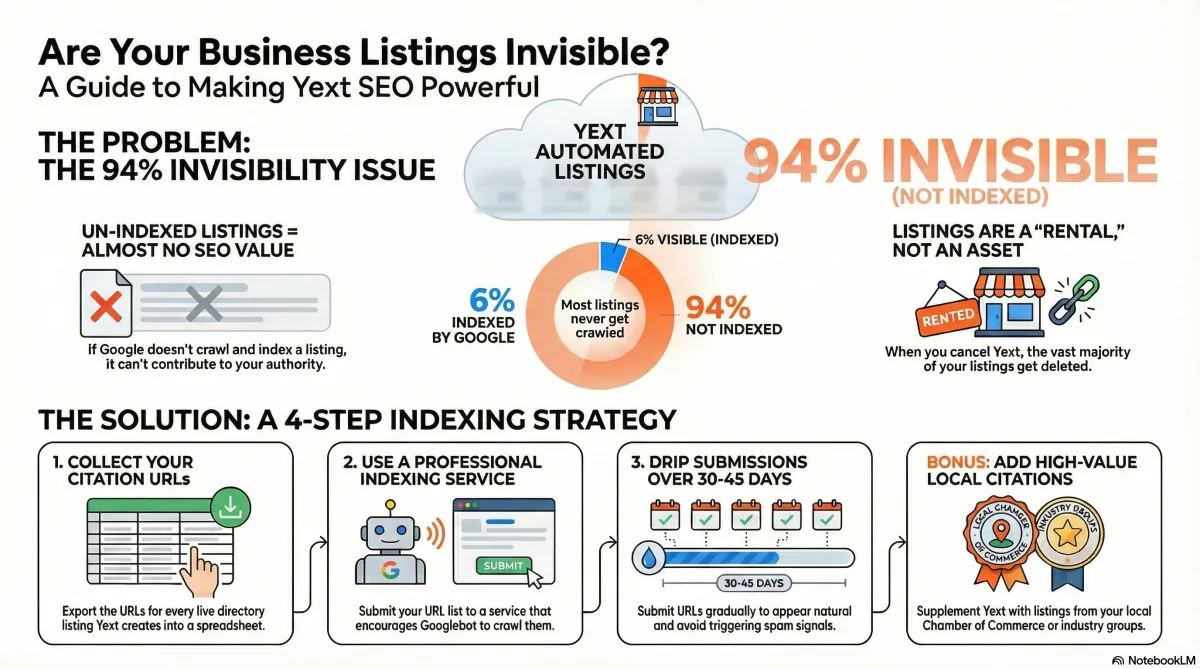
A test conducted on citations built by Yext revealed that only about 6% were actually indexed by Google, even weeks after going live (video included). This means a staggering 94% of the listings provide almost no SEO value. Without being indexed, your listings aren't building your authority in local search results.
Why does this happen? The reason is that many automated services distribute your business information to a broad network of low-priority websites. These sites often have low domain authority and thin crawl budgets, meaning Google doesn't consider them important enough to visit frequently. The result is that your listings never get seen by Google.
...you’re just decorating the internet, not building local SEO authority.
2. The Library Analogy: Why 'Live' Doesn't Mean 'Found'
To understand the problem, we need to distinguish between a "live" listing and an "indexed" one. The "Giant Library Analogy" makes this distinction clear.
Imagine the entire internet is a massive library with billions of books, and Google is the librarian in charge of the central card catalog—the only way to find anything.
An un-indexed listing is like a new book placed on a dusty shelf in the library's basement. The book exists, but since the librarian hasn't added it to the card catalog, it's impossible for anyone to find. It is physically present but functionally lost.
An indexed listing is a book the librarian has found, cataloged, and added to the central system. Now, when someone searches for that topic, the librarian can point them directly to its location. The book is discoverable.
The core principle is simple, but it represents two escalating levels of worthlessness for your business:
Not Indexed: A listing that is crawled but not added to Google’s index has almost no value. It may serve as a minor trust signal, but it won't help you rank.
Not Crawled: A listing on a page Google never visits has no value whatsoever. From Google's perspective, it doesn't exist.
3. The Renter's Trap: Why Your Listings Disappear When You Cancel
A critical question is what happens to these listings if you cancel your subscription service. This isn't speculation; a direct test on a client account provided a definitive answer: they disappear.
When the Yext service was cancelled, the vast majority of the listing URLs were removed and became 404 "Not Found" errors. Worse, even the very few listings that had been indexed lost their status. This confirms you are not building a permanent digital asset for your business. You are temporarily renting digital space, and the moment you stop paying, your presence is erased.
4. Take Control: A 4-Step Process to Force Your Listings to Work
If you're committed to using a service like Yext, you can still extract real value, but it requires active effort on your part. The goal is to force Google to find and index the citations you're paying for.
Here is a four-step process to turn your invisible listings into valuable assets:
1. Get Your URLs: After your listings go live, collect the complete list of all your citation URLs. Export them or copy them into a spreadsheet for easy management.
2. Use an Indexing Service: Find a reputable indexing service that can test each URL for indexability (i.e., ensure it's not blocked from Google) and then submit your list of URLs to Google through various channels like fetch requests, ping networks, or link pyramids to encourage crawling.
3. Use a Slow Drip Rate: Do not submit all your URLs at once. For a list of 70 citations, you should "drip" the submissions gradually over 30–45 days. This appears more natural to Google and avoids triggering potential spam signals.
4. Track Your Results: After submitting your URLs, you must monitor which ones successfully get indexed. Verify your results by spot-checking with Google search operators like site:yourcitationurl.com/example-citation
As a bonus strategy, supplement these generic listings with high-value, relevant citations. Pursue listings with your local Chamber of Commerce, industry associations, or local networking groups. Even if these links are on low-traffic pages, once indexed, they carry far more contextual and geographic trust than a random directory listing.
Conclusion: Stop Decorating and Start Building
The goal of local SEO isn't just to be listed everywhere; it's to be indexed so you can be found by customers. The work of building citations is not finished when the listing goes live. It's finished when you can verify that Google has seen it and added it to its index.
Verified indexing is the only metric that truly matters for local search visibility. It's the difference between wasting your budget and making a real investment in your business's online authority.
Most people sleep on this. Don’t be one of them.