




Introduction to Indexation
Is Your Masterpiece Invisible?
4 Truths About Google Indexation You Can't Ignore
You’ve done everything right. You researched keywords, crafted a brilliant piece of content, and hit "publish." You wait for the traffic to roll in, but you’re met with silence. Your article, the one you poured hours into, is invisible on Google. This frustrating scenario is all too common, and it usually points to a single, overlooked foundational step: indexation.
Indexation is the process of Google adding your webpage to its massive, searchable library. If your page isn't in the library, it simply doesn't exist to searchers. This article breaks down the most impactful and surprising truths about getting your work seen by Google, moving it from invisible to discoverable.
1. Google Seeing Your Page Isn’t the Same as Listing It
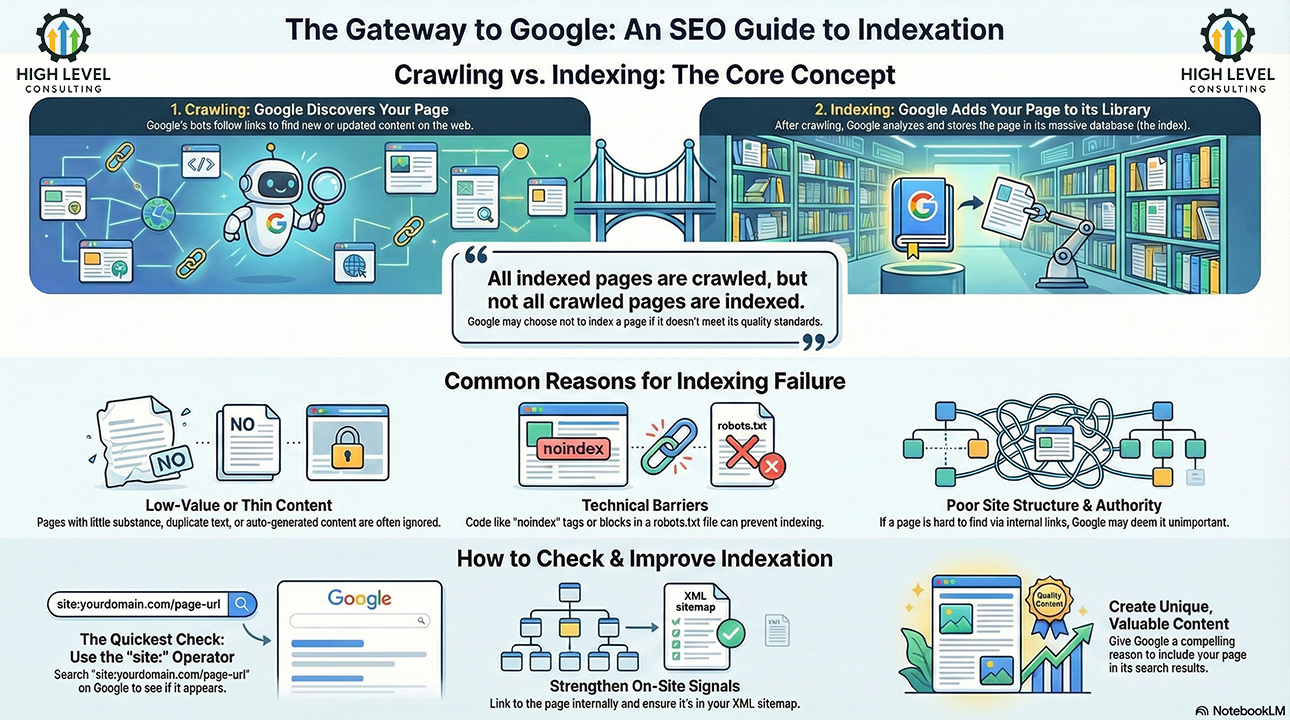
The most common misunderstanding in SEO is the difference between crawling and indexing. Crawling is when Google's bots discover and visit your page to see what's there—think of it as Google seeing your page. Indexing, however, is when Google evaluates that page and decides to add it to its "official library" of searchable content.
This distinction is critical because it highlights a fundamental rule of how Google Search works.
“All indexed pages are crawled, but not all crawled pages are indexed.”
This means Google can visit your page repeatedly but still choose not to list it if it doesn't meet the necessary quality standards. Just because Googlebot has seen your content doesn't guarantee it a spot in the search results.
2. Your "Perfect" Content Is Worthless If It's Not Indexed
Without indexation, a page is completely invisible. It cannot appear in search results, rank for keywords, generate organic traffic, collect backlinks naturally, or influence your site's topical authority. It’s the absolute gateway to every other benefit SEO provides. You can have the fastest-loading, most keyword-optimized page in the world, but its value is zero until Google adds it to the index.
The stakes are incredibly high because, without this crucial first step, every other SEO effort is wasted.
But if Google doesn’t index your pages, none of it matters.
3. You Can Check Your Index Status in 5 Seconds
You don't need complex tools to get a quick, definitive answer on whether your page is in Google's library. You can use a simple search operator directly in Google.
To check your page, type the following command into the Google search bar:
site:https://yourdomain.com/your-page-url
The result is instant and clear:
If your URL appears in the search results, your page is indexed.
If you see a "no results found" message, your page is not indexed.
This simple check is empowering because it gives you an immediate, real-world verification. For a deeper diagnosis of why a page might not be indexed, your next step should be Google Search Console (GSC), which provides detailed crawl and indexation reports.
4. Indexation Isn't Automatic—It's Earned
Google doesn't index every page it finds. It makes a conscious choice based on signals of quality, trust, and importance. If a page is crawled but not indexed, it's often because it fails to demonstrate its value or has a technical issue blocking it.
Some of the most common reasons Google chooses to ignore a page include:
Technical Blocks: A page might have a
noindextag that explicitly tells Google not to list it, or it could be restricted in your site’srobots.txtfile. These are often the first things to check.Low-Value or Thin Content: Pages that lack substance or offer no unique insights are often passed over. This includes duplicate content from other sites or auto-generated text.
Poor Internal Linking: If a page is an orphan and not linked to from other important pages on your site, Google may assume it’s not valuable.
Low Trust Signals: Brand-new websites with no authority or inbound links often face delays, as Google has no established reason to trust their content yet.
To encourage indexation, you must actively prove your content is worthy by ensuring it has unique value, is technically accessible, and is integrated into your site's structure.
Conclusion
Mastering indexation is the non-negotiable first step in any successful SEO strategy. Before you worry about rankings, keywords, or traffic, you must ensure your content has been admitted into Google's searchable library. Master this first, and everything else in SEO becomes easier, faster, and more effective.
Now that you know the gate exists, what will you do to ensure your best content gets through?