
How to Multiply the SEO Power of Your Google Reviews
You’re Getting Reviews. Awesome. But Are They Working Hard Enough?
If you're already asking customers to leave reviews, first of all—good on you. You're ahead of the local businesses still living in the “word of mouth is enough” era. And if those reviews are mostly five-star ratings? Even better. That means you're doing something right.
But here’s the thing: not all reviews are created equal.
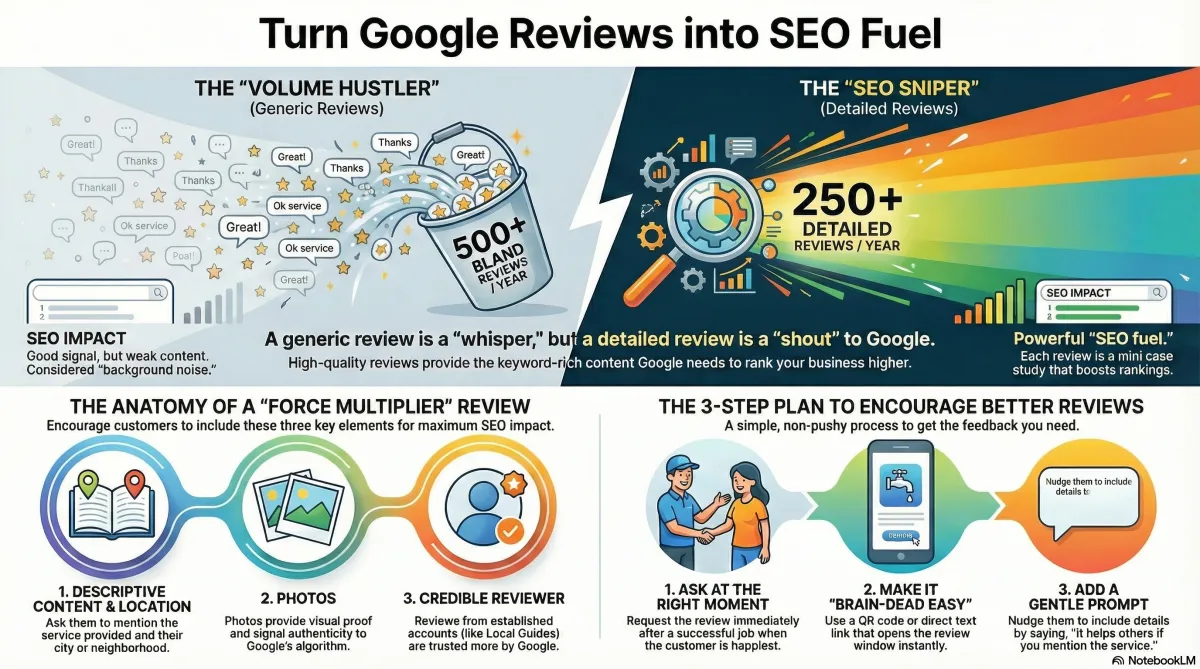
A five-star rating with one word (“Great!”) is nice. It’s a pat on the back. It’s technically helpful. But when it comes to local SEO, it’s a whisper—versus the shout of a longer, photo-filled review from a user who mentions what you did, where you did it, and how fast you saved the day.
It’s not that short, generic reviews are bad. They’re still part of the engagement signal Google looks for. But if you want to turn your reviews into a true competitive advantage, it’s time to think beyond the star count.
You’re not just collecting praise. You’re feeding Google’s machine.
This post will show you how to turn good reviews into great ones—and great ones into ranking powerhouses. We’ll talk about how to encourage better content, why some reviews carry more weight than others, and how even small tweaks to your review strategy can give your local SEO a serious boost.
The Company Showdown – Quantity, Quality, and the Sweet Spot
Let’s talk about three fictional companies. None of them are doing anything wrong—but only one of them is really winning in the local SEO game.
Company 1: The Bare Minimum Crew
They’ve got five reviews. Most are short. Maybe one has a photo. It’s clear someone asked their mom, their neighbor, and a guy from softball league to write something “real quick.”
👉 Result? They’ve got a pulse online—but barely. Not much for Google to chew on.
Company 2: The Volume Hustlers
These guys are racking up 15 reviews a week. Impressive! But dig into them and... yikes. It’s a parade of vague one-liners:
“Great service!”
“Will use again.”
“Quick and easy.”
Are they real? Probably. Are they helpful? Not really.
👉 Result? Google sees the volume, so they’re definitely in the game—but most of those reviews are background noise. Good signal, weak content.
Company 3: The SEO Snipers
They’re getting maybe 3–5 reviews a week. But these reviews? They’re gold. Customers are writing paragraphs, mentioning exactly what got fixed, where they’re located, how fast it happened, and even uploading before/after pics. The reviewers often have profile photos, and a lot of them are Local Guides.
👉 Result? This is SEO fuel. Every review is a mini case study that Google can index, understand, and rank for.
Now here’s where it gets interesting:
Company 2’s 500 bland reviews per year still matter. That volume alone gives them traction. But if Company 3 gets 250 high-quality reviews in that same time—rich with context, images, and credibility—they can absolutely compete.
It’s not about “more is bad” or “quality only.” It’s about multiplying the power of every review you get. Give Google stronger signals, and it will reward you for it.
What Makes a Review a Force Multiplier?
Not all reviews are created equal, even if they all have five shiny stars next to them. Some reviews just carry more weight with Google. They don’t just say “this business is good”—they tell Google why, where, and how this business is crushing it. And that, my friend, is what we call a force multiplier.
Here’s what separates the average “Nice job!” review from the kind that actually boosts your search visibility:
1. Descriptive Content
A review that says “Fixed my AC issues in under two hours and had my house cool before dinner” is worth way more than “Great service.” Why? Because it gives Google clues about what you do, how fast you do it, and what kind of problem you solve. That’s keyword-rich, user-generated content—and it’s gold.
2. Geographic Relevance
If your customer drops a line like “They came out to my place in Peachtree City on a Saturday afternoon”—boom. Now you’ve got location data in a review. Google connects that to your service area and starts reinforcing your relevance for local searches.
3. Photos
Visual content doesn’t just help human users—it gives Google more context. A photo of the fixed HVAC unit, a clean install, or even the outside of your storefront adds authenticity and keeps the review from getting filtered out by Google’s spam bots. Bonus: photo reviews also tend to get clicked and read more.
4. Reviewer Credibility
You can’t control who leaves you a review, but you can encourage happy customers to share their full experience. When a reviewer has a profile photo, multiple past reviews, or happens to be a Local Guide, Google tends to trust their feedback more. These reviews are more likely to stick during Google’s random review purges and may carry more weight in your ranking signals.
So no—you don’t need to chase down Local Guides or worry about whether a customer is “important enough.” You just need to create a review experience that attracts better feedback. A good review is helpful. A detailed, geo-relevant, photo-filled review from a credible user? That’s a weapon.
How to Encourage Better Reviews Without Being Weird
Here’s the part where most businesses freeze up. They know they need reviews. They ask for them. But when it comes to getting better reviews, they either get awkward or pushy—or worse, they don’t ask at all.
Let’s fix that.
You don’t need a script. You don’t need to bribe anyone. You just need to nudge your customers in the right direction at the right moment—and make it ridiculously easy for them to leave the kind of review that helps your business grow.
Set the Scene for a Strong Review
The best time to ask for a review is right after the job is done and the customer is happy. Whether it’s at the register, in a follow-up text, or via a thank-you email, all you have to do is plant the seed:
“Would you mind sharing a quick review? It really helps when folks mention what service we did and where they’re located—plus, if you have a photo, that’s even better!”
Simple. Not weird. Totally effective.
Make It Easy (Seriously, Brain-Dead Easy)
Don’t just say “leave us a review.” Hand it to them on a silver platter:
Create a custom QR code they can scan on their phone at checkout
Use review request software like High Level
Send a text with a direct Google review link that opens the review window instantly
If your customer has to search for your business on Google, you’ve already lost them.
Add a Gentle Prompt (Not a Script)
You're not trying to control what people say—you’re helping them say what they already feel in a way that helps others (and Google) understand why you’re awesome.
Try something like this in your email or message:
“Thanks so much for choosing us! If you have a moment to leave a review, it helps a ton. Things like what we helped with, how fast we got it done, or even where you're located can be super helpful for others. And if you have a pic—those are always awesome too!”
No pressure. No sleaze. Just a friendly nudge in the right direction.
Strong reviews don’t happen by accident. But they do happen naturally when you make it easy and give your happy customers just a little guidance.
What’s a Google Local Guide, Anyway?
If you’ve ever noticed someone leaving a review on Google with a little badge next to their name—“Local Guide Level 6” or “Level 9” or whatever—that’s not just some made-up internet flair. That person is part of Google’s Local Guide program, and yes, it actually matters.
Here’s the deal:
Google created the Local Guide program to reward people who contribute helpful content to Google Maps—like reviews, photos, Q&A responses, and more. In exchange, these users earn points and badges that show their level of activity and trust.
You can read the official info here:
➡️ Google Local Guide Program Overview
➡️ How the Local Guide Program Works (Google Support)
Local Guides tend to:
Leave more detailed reviews
Upload photos or videos
Answer community questions on business profiles
Suggest edits and updates to business listings
They’re basically the power users of Google Maps—and their contributions tend to carry more influence with Google’s algorithms.
And while your average business owner can’t see whether a reviewer is a Local Guide ahead of time, the signs are often there: profile pictures, longer reviews, more contributions, and that shiny badge.
Now that they know what Local Guides are, we can transition smoothly into the section about why their reviews carry more weight.
Why Local Guide Reviews Can Pack a Punch (and What’s Coming Next)
Now that you know who these Local Guides are—Google’s MVPs of Maps—it makes sense that their reviews can have a little extra kick.
These aren’t just casual users dropping in to say “Nice place.” These are seasoned contributors who Google trusts to provide helpful, accurate information. And when they leave a review on your business, it often hits harder than a standard one.
Here’s why Local Guide reviews stand out:
They stick – Google is more likely to trust and preserve reviews from established, active accounts
They go deeper – Local Guides tend to leave longer, more detailed reviews (because that’s how they earn points)
They bring receipts – Photos, videos, specific descriptions—all of which signal authenticity to both users and Google
They’re seen as trusted voices – Their contributions feed directly into Google’s local ranking and content systems
In short: these people don’t just review your business—they help define how Google understands your business.
So… How Do You Get Local Guides to Review You?
Here’s the beautiful part: you don’t have to do anything special.
If you’re already encouraging detailed reviews and making it easy to leave them, Local Guides will find you. They’re everywhere, and they’re always looking for their next review-worthy experience.
What you can do is make sure you’re creating the kind of review process and customer experience that naturally attracts them:
Ask for reviews at the right moment
Make the process easy and fast
Gently encourage detail and photos
Deliver great service that’s worth writing about
Do that, and the Local Guides will come.
👀 What’s Coming Next…
This post is just the beginning. In upcoming content, we’ll dive deeper into what makes Local Guides special, including how they can:
Shape your Google Business Profile Q&A section to your advantage
Use the Suggest Edits feature to help (or hurt) your online presence
Become secret allies in your battle for local visibility
Bottom line? You don’t need to obsess over Local Guides—but you should understand how to create reviews that attract them.
Take Action – Make Every Review Count
Let’s be clear: every 5-star review helps. But if you want your reviews to do more than just make you feel warm and fuzzy inside—if you want them to actually boost your rankings, outperform your competitors, and turn Google’s algorithm into your hype man—you’ve got to start thinking bigger.
Start by updating how you ask for reviews. Don’t just ask for one—ask for the right kind.
Encourage your customers to mention:
What service you provided
Where they’re located
How fast you helped
And if they can throw in a photo? Even better.
You don’t need to chase Local Guides. You don’t need a perfect system.
You just need to nudge your happy customers to give Google what it’s already looking for.
Your competition is probably still begging for “a quick review.” You’re about to turn every one of yours into an SEO asset.
