




How a Simple 'Don't Replace' Strategy Generated a 72x ROI for an Enterprise Client
How a Simple 'Don't Replace' Strategy Generated a 72x ROI for an Enterprise Client
Introduction
For many agency owners and consultants, selling their services is the single biggest challenge. This frustration is amplified when targeting large companies already entrenched in enterprise-level systems. You have a powerful solution, but the client is deeply invested in a tailor-built ERP and has a clear mandate: "we only work in HubSpot." The conventional approach—trying to replace their core system—is a losing battle. It’s a classic case of the "hammer and nail" trap, where we try to force our one solution onto every problem. But what if the most profitable strategy isn’t to compete, but to supplement? This article breaks down five key takeaways from a real-world case study that transformed this philosophy into a massive return on investment.
1. Takeaway 1: Stop Competing. Start Supplementing.
The core philosophy behind this success is to abandon the replacement mindset. Trying to uproot a client's tailor-made, entrenched system is a losing strategy. Companies invest hundreds of thousands of dollars and immense manpower into these platforms, making any proposed migration a "very, very uphill battle."
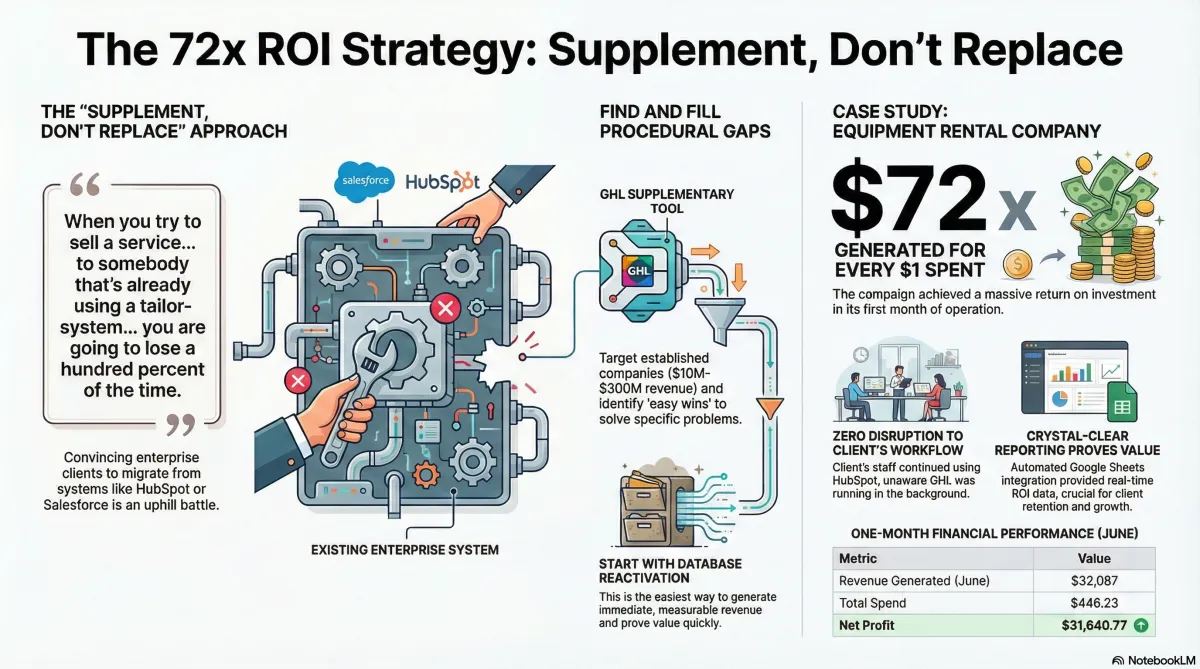
"When you try to sell a service or a product to somebody that's already using a tailor-made system for their industry you are going to lose a hundred percent of the time." – Adam McInnes
Instead of fighting this battle, the winning move is to identify and fill procedural gaps their current system doesn't address. In this case study, the agency used their flexible toolset to provide marketing automation functionality that would have cost the client an additional $30,000 annual fee from HubSpot. By positioning their service as a supplemental tool that saves money and enhances existing operations without disruption, they followed the path of least resistance, making it infinitely easier for a high-value client to say "YES."
2. Takeaway 2: The Easiest Sale is to the Biggest Client.
This strategy flips conventional wisdom on its head by actively targeting established, high-revenue companies. The analytical insight here is that selling a high-ticket solution to a large organization is often a simpler and faster sales cycle than selling a low-cost subscription to a small business owner.
The target "sweet spot" for this model is companies with annual revenues between $10 million and $200 million.
• They are problem-aware. These companies have already identified significant operational issues and, crucially, have the resources to pay for effective solutions.
• Contracts are higher value. A solution generating substantial revenue for a multi-million-dollar company can command fees of $50,000 to $150,000 per year, and clients don’t hesitate to pay for tangible impact.
• The sales cycle is more efficient. Selling a $50,000 annual contract to a company focused on ROI is often an easier conversation than selling a $297/month subscription to an owner-operator scrutinizing every line item.
3. Takeaway 3: The Quickest Win is Hiding in Their Old Data.
The fastest way to demonstrate value is by solving a costly business problem with a simple, high-impact strategy. In this case, the client faced two key challenges: significant revenue leakage from missed sales opportunities and an expensive, non-scalable solution—hiring more salespeople at 100,000−120,000 each.
The answer wasn't a complex new system, but a straightforward database reactivation campaign. Described as the "easiest quickest money that you can make for a company," this approach delivered measurable results within the first 30 days by targeting a list of "Missed Rentals" lost due to pricing or inventory issues. The core of the solution was a simple, straight-line text message sequence, a fact that prompted expert Adam McInnes to note, "that is the most simple example of a database reactivation campaign I've ever seen." This proves that the most profitable workflows don't need to be complicated; they just need to solve a specific, expensive problem.
4. Takeaway 4: The Secret to Retention is Relentless Reporting.
To retain and grow a high-value contract, you must transparently prove your worth with "crystal-clear reporting." This is non-negotiable, as the personal stakes are high. As project lead Richard Whirley stated, "I get fired if I can't give a good ROI justification."
To guarantee data integrity, a unique "Relentless Follow-up" workflow was created. This was an internal-facing system that sent automated notifications to the client's staff every three hours until they submitted a form confirming if a reactivated lead resulted in a won or lost deal, along with its exact revenue. This data was pushed to a Google Sheet, providing a real-time ROI dashboard.
This meticulous reporting isn't just for retention; it's a powerful "land and expand" growth strategy. By proving undeniable success across the initial 13 locations, the agency built an airtight business case to roll the solution out to the client's other 30-40+ locations, turning a successful engagement into a potential seven-figure impact on the client's business.
5. Takeaway 5: Sell a Solution, Not Software (The Results Speak for Themselves).
A crucial mindset shift is required for this model. The client isn't buying software; they're buying a solution to a business problem like "recover lost revenue." The platform used, HighLevel, is a "blank slate." Its "very Bare Bones" nature is not a weakness but its core strength.
This is best explained with an "Android vs. iPhone" analogy. Niche CRMs are like a closed "iPhone"—they do what they do out of the box. HighLevel is like an "Android"—a flexible platform you build to solve any specific problem. Its power is in its customizability.
"...that's not a bug it's a feature." - Richard Whirley
Ultimately, the results are what matter. By focusing on solving a specific problem instead of selling software features, the case study produced staggering results in a single month.
• Revenue Generated: $32,087
• Total Spend: $446.23
• Return on Investment: $72 for every $1 spent
Conclusion
The path to securing lucrative, long-term contracts with enterprise clients doesn't require going head-to-head with industry giants. The true opportunity lies in shifting from a vendor who sells software to a strategic partner who identifies and solves procedural gaps. By embracing a "supplement, don't replace" mindset, you can deliver undeniable ROI, become an indispensable asset, and unlock massive growth for both your client and your own business.
What procedural gap in your ideal client’s business could you solve tomorrow?