

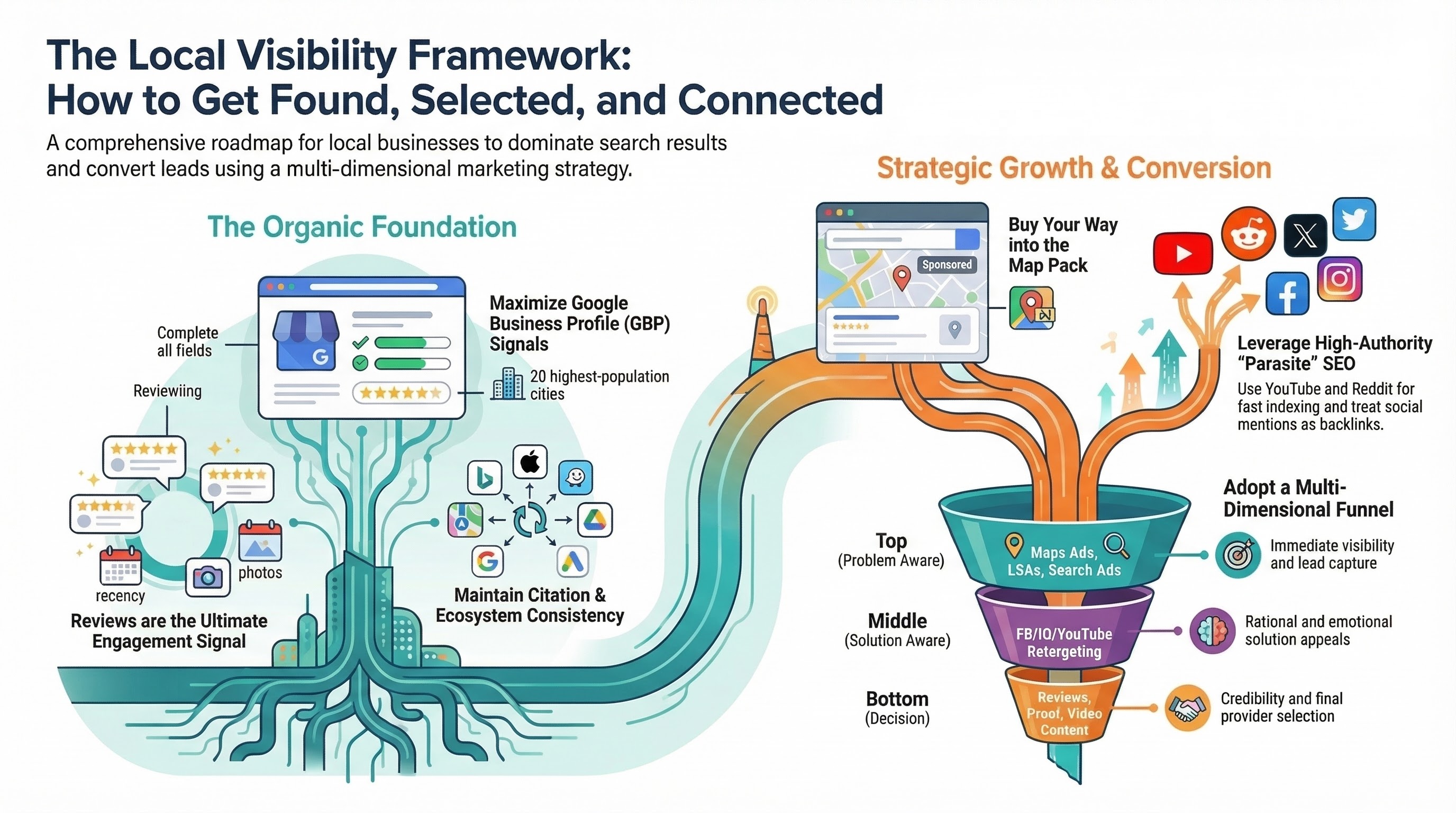
Get Found. Get Selected. Get Connected
Here’s a basic framework that you can immediately implement with your clients and customers, and differentiate yourself from most of the “gurus” that you’re competing against.
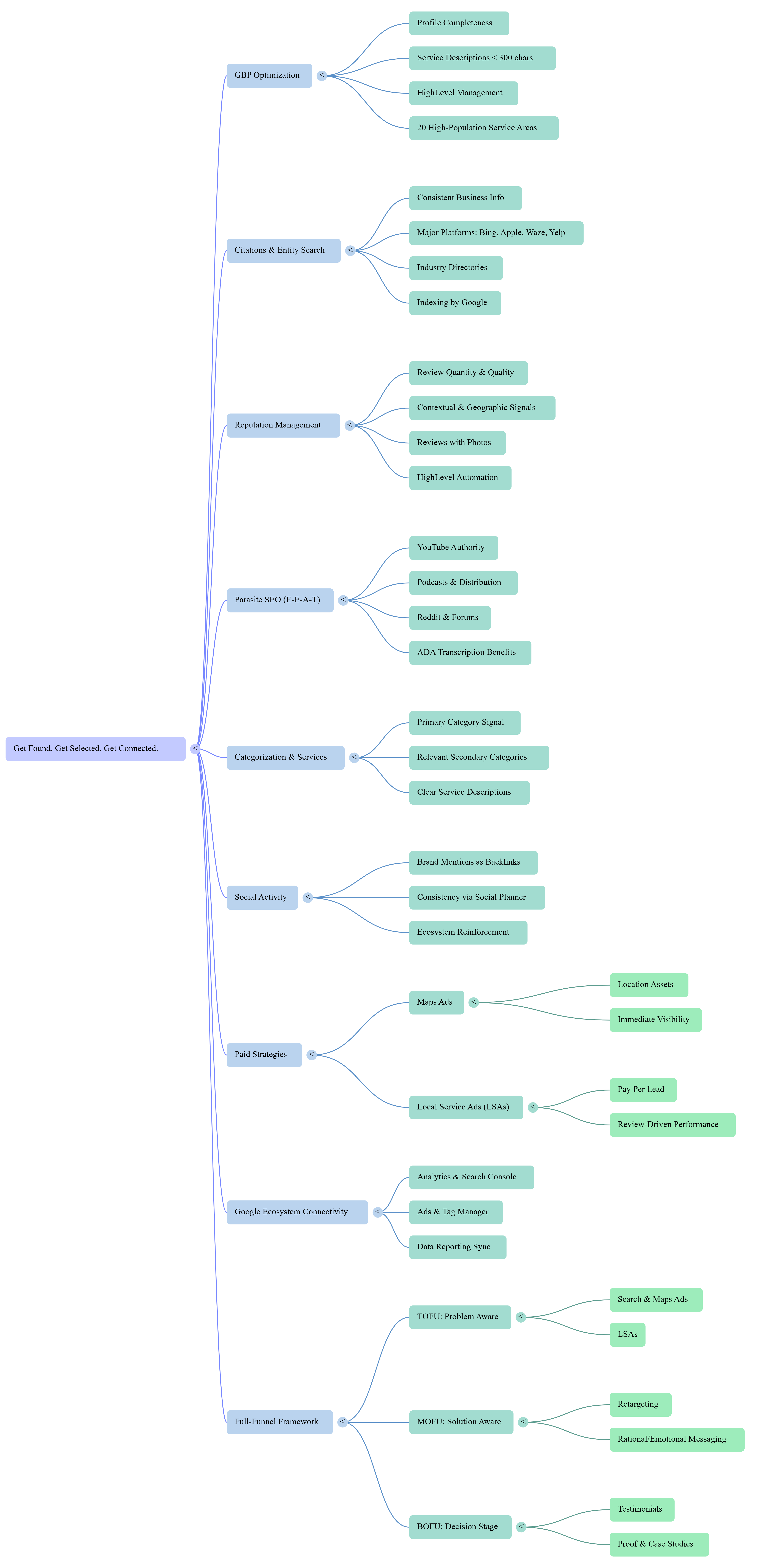
1. GBP OPTIMIZATION
You would be shocked how many “optimized” profiles are missing half their information.
Services, service descriptions (keep them under 300 characters), categories, photos, posts, and review responses can all be managed directly inside of HighLevel (message me for a free trial).
The only field you can’t adjust there is Service Areas.
And before someone jumps in with the usual “service areas don’t matter” comment… I generally assume that if Google gives you a structured data field, they probably intend to use it.
Pick the twenty highest-population cities that physically touch the business location and add them. It takes about three minutes.
2. CITATIONS (yes, they still exist)
Every year someone confidently announces that citations are dead.
Then you look up the businesses dominating competitive metro markets and notice something funny: they all have them.
Bing Places. Apple Maps. Waze. Yelp. Industry directories.
Google has been moving toward entity-based search for years. Consistent business information across trusted sources helps confirm that the entity actually exists.
Will citations alone make you rank? No.
Will consistent, accurate, indexed listings hurt your business? Also no.
Hint: I personally despise Yext and any other “auto-citation” provider, but whatever you use, just get them indexed by Google for the love of all things good.
3. REPUTATION MANAGEMENT
Reviews are one of the strongest engagement signals a local business can generate. (This wasn’t always the case, ironically- but it is now.)
The businesses that consistently win in local search almost always have more reviews (in quantity/quality/recency), better ratings, and more recent activity than their competitors.
You’ll hear people argue that keywords or locations inside reviews don’t matter. Maybe they don’t move the needle dramatically — but contextual signals have never hurt Google’s ability to understand WHO you are, WHAT you do, and WHERE you do it.
Two interesting observations worth noting:
- Reviews that include photos tend to carry more weight according to Google’s Local Guide documentation.
- Reviews left by accounts with actual profile thumbnails tend to survive review purges more often than blank accounts. (You can’t really control anything about this, but it’s an interesting side note.)
HighLevel already has reputation management built in, so this should just be part of your standard onboarding process and operating procedure.
4. PARASITE SEO (Leverage Authority Platforms)
To get a fast track on establishing E-E-A-T (Expertise, Experience, Authority, Trust), leverage platforms Google already trusts and recognizes.
YouTube, Reddit, podcast platforms, industry publications, forums — these all carry significant authority.
YouTube is particularly powerful right now because videos show up constantly in search results and AI Overviews, often indexing within an hour. (Obviously Google owns YouTube, so this should surprise absolutely no one.)
Podcasts are another interesting opportunity because they distribute content across multiple high-authority platforms simultaneously.
All of this reinforces Google’s understanding of your experience, expertise, authority, and trust.
LIFE HACK: To be compliant with the ADA, these sites transcribe every word of your video/podcast for closed captions. Therefore, Google knows every word in them… It’s tough to comprehend how much contextual and geographic relevance you can establish in a 10 minute conversation versus trying to write it in a blog post.
5. CATEGORIZATION & SERVICES
Your primary category is one of the strongest signals inside a Google Business Profile.
Secondary categories matter too, but this is not the place to get creative and start stuffing anything that vaguely sounds related.
Choose the categories that actually match the business model, then organize services underneath them with clear descriptions that reinforce what the business does.
Google is pretty good at understanding context now. You don’t need to trick it.
6. SOCIAL ACTIVITY
AI-driven search is becoming very good at digesting contextual data across the web, and brand mentions are becoming more important signals for relevance and recency.
This doesn’t mean every social post needs to go viral.
But consistent mentions from customers, vendors, manufacturers, and industry peers reinforce that the business actually exists and is active.
HighLevel has a social planner built in, which makes maintaining a consistent cadence pretty easy.
Think of it this way: Social Mentions are the new Backlink. They have a shorter lifespan, but they are a LOT easier to get.
7. MAPS ADS
Search Ads + Location Assets = Buying your way into the Maps Pack
One of the most underutilized strategies I see agencies miss is attaching a Location Asset to Google Search campaigns.
When you do this, your ads become eligible to appear directly inside Google Maps.
In other words, you’re essentially buying your way into the Maps Pack.
That includes areas where you don’t rank organically yet or areas where it could take months to climb.
Even if you’re a hardcore SEO purist, sleeping on this strategy doesn’t make much sense. It lets you expand visibility immediately while organic rankings are still developing.
Listen, I do Local SEO for a living in very competitive, high-dollar industries. Those Maps ads can turn your 3 pack into a 4 pack and make the phone ring QUICKLY while you’re working on the stuff that’s solidifies your spot in the organic 3 pack.
8. LOCAL SERVICE ADS
If your industry qualifies for Local Service Ads, they’re worth running.
These appear above traditional search ads and often generate extremely high-intent leads. They are pay per LEAD instead of PPC, and they are MUCH easier to run than Search Ads.
There are plenty of discussions about optimizing exposure inside LSAs, but one factor consistently impacts performance: reviews.
Businesses with stronger ratings and more review activity tend to perform significantly better.
I have some life hacks on maximizing your visibility with LSAs, but I’ll save them for another post.
9. CONNECT YOUR GOOGLE ECOSYSTEM
This one still surprises me. A lot of businesses run ads without connecting the Google properties that power their marketing ecosystem.
Analytics, Search Console, Google Ads, Google Business Profile, and Google Tag Manager should all be associated with each other.
These platforms constantly report user engagement data back to Google — how people find your business, how they interact with your site, whether they convert, and what actions they take afterward.
The clearer that data becomes across Google’s ecosystem, the easier it is for their systems to understand how people interact with your business.
10. STOP BEING ONE-DIMENSIONAL
Not every customer is ready to hire you the moment they discover your business.
People move through stages.
At the top of the funnel they’re problem-aware. That’s where search ads, Maps ads, LSAs, and Bing ads perform well.
In the middle of the funnel they know they need help but haven’t chosen a provider yet. Retargeting through platforms like Facebook, Instagram, and YouTube becomes powerful here.
By the bottom of the funnel they’re deciding between providers or deciding whether to do the project at all. Testimonials, proof, and credibility become the deciding factors.
Your funnel should match their awareness stage. See below
Top of Funnel (TOFU) – Problem Aware.
Example: “Tree removal near me”
Best channels:
Search Ads
Maps Ads
LSAs
Bing Ads
Middle of Funnel (MOFU) – Solution Aware.
They know they need help but haven’t chosen you.
Retarget them with rational AND emotional messaging.
Examples:
Rational: “Free stump removal with any tree over 40 feet.”
Emotional: “Protect the roof that protects your family.”
Best channels:
Facebook
Instagram
YouTube
Bottom of Funnel (BOFU) – Decision Stage
Now they’re choosing between providers. Use testimonials and proof.
Example: A customer explaining how removing the tree saved them thousands in roof damage before a storm.
This is where reviews, reputation, and video content shine.
There will always be debates about ranking factors. Algorithm updates kick us all in the teeth from time to time.
But businesses that dominate online visibility tend to have one thing in common: they consistently optimize the signals they actually control.
When you do that long enough, you stop hoping Google notices you — and start giving it exactly the information it needs to show your business to the people searching for it.