




Your CRM's Attribution is Flawed: 5 Ways to Uncover Your True ROI
Introduction: The Attribution Black Box
It’s one of the most common frustrations for marketers: you know your campaigns are generating leads, but you can't prove precisely which channels are driving actual sales opportunities. You see activity, but when it comes time to connect marketing spend to revenue, the data is ambiguous. You're stuck in an attribution black box, forced to rely on guesswork.
Most CRMs, including High Level (GHL), use a default attribution model. It typically relies on dynamic models like first or last touch, which are useful for understanding a contact's general journey. However, as your business grows and handles multiple deals from the same people, this model's limitations become a major liability. It can't tell the full story of how different campaigns contribute to your pipeline over time.
This article will reveal a more powerful way to track marketing success. By shifting attribution from the contact to the opportunity, you can unlock a new level of clarity, connect every dollar in your pipeline to its origin, and finally prove your marketing's true value.
1. Your CRM's Big Mistake: Tracking People Instead of Deals
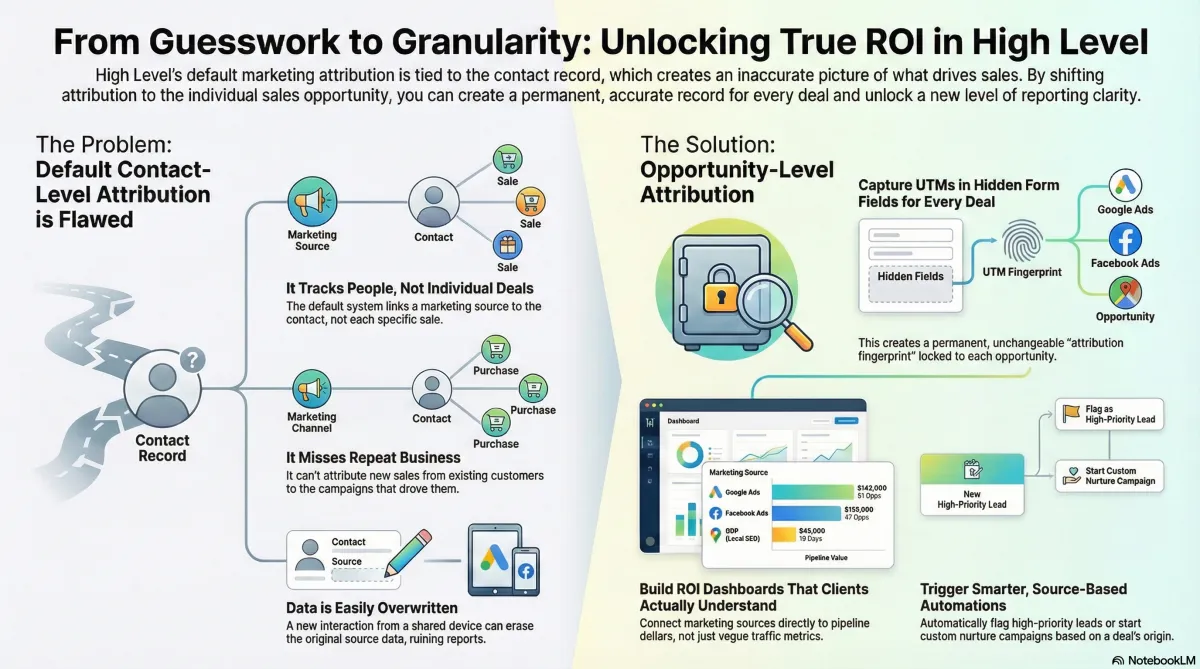
The fundamental flaw in most default CRM attribution systems is that they tie marketing source data to the contact record. When a person fills out a form for the first time, the system records where they came from and attaches that information to their profile. This process works fine, but the fundamental flaw is that the data is tied to the wrong object in the database.
This model is flawed for several critical reasons:
A single contact can generate multiple opportunities over time. A client might request a quote from a Google Ad, then six months later, click a link in your newsletter to schedule a service call. Contact-level attribution only credits the first interaction, leaving the second deal completely unattributed.
It cannot handle shared devices or form reuse. This is especially common in industries like home services, equipment rentals, or franchise businesses, where the same contact record may be used by multiple people (e.g., contractors, admins, spouses). If one person's form submission overwrites another's source data at the contact level, your reporting becomes instantly inaccurate.
The solution is to create custom fields at the opportunity level (e.g., utm_source, utm_campaign) and use hidden fields in your forms to capture this data upon submission. This attaches a static, locked-in snapshot of attribution data to every single opportunity. This ensures each deal has its own unique source, campaign, and origin story preserved forever, independent of the contact's history.
2. Build ROI Dashboards That Finally Make Sense
By capturing UTM data on each opportunity, you can build custom dashboard widgets that tie real pipeline dollars directly to specific marketing sources. This moves your reporting beyond vague, high-level metrics like "traffic" or "leads" and into the language that clients and executives understand: revenue. By using a combination of 'Count' widgets to show the number of opportunities and 'Sum' widgets to show their total pipeline value, you can create a crystal-clear performance overview.
Instead of presenting a general overview of website activity, you can create a report that looks like this:
Facebook Ads → 47 opportunities worth $128k
Google Ads → 61 opportunities worth $142k
GBP (Local SEO) → 19 opportunities worth $45k
That’s the kind of reporting clients want.
3. Turn Your Sales Pipeline into a Live Attribution Report
One of the most immediate and practical benefits of opportunity-level attribution is the ability to analyze your sales pipeline on the fly. By storing marketing data like utm_source or utm_campaign on the opportunity record itself, you can use your CRM's native filtering tools for instant analysis.
This simple capability allows you to answer critical business questions in seconds, right from your pipeline view:
“How many deals are in the pipeline from LinkedIn vs. Facebook?”
“What’s the current value of all opportunities generated from our August promo?”
This transforms a standard sales pipeline into a dynamic, real-time marketing performance dashboard without the need to build complex, standalone reports.
4. Let the Lead's Origin Automate Your Sales Process
When attribution data lives on the opportunity, it can be used as a powerful trigger for workflow automations. Because the UTM fields are tied to the deal, not just the contact, you can create precise rules that kick off specific sales and marketing processes. This level of flexibility is not possible with GHL's native contact-level attribution.
Here are a few concrete examples of how this works:
Opportunities from Google Paid Ads? (e.g., when utm_medium is 'paid') → Flag them as high-priority and send instant notifications to the sales team.
Opportunities from your newsletter? (e.g., when utm_source is 'newsletter') → Automatically drop them into a long-term nurture campaign.
Opportunities from a retargeting campaign? (e.g., when utm_campaign contains 'retargeting') → Add them to a custom Smart List for specific follow-up.
5. Close the Loop: Tell Your Ad Platforms What's Actually Working
For marketers who want to move beyond just reporting on attribution, this is an advanced move that directly impacts campaign performance. The goal is to feed the high-quality opportunity data you've captured in your CRM back to your advertising platforms.
Using a tool like Zapier or a webhook, you can pass opportunity data from GHL back to platforms like Google Ads and Facebook Ads. By doing this, you are "closing the loop." You are telling the ad platforms which clicks led to not just a form fill, but a real opportunity with a specific pipeline value. This allows their algorithms to optimize your campaigns based on real opportunity-level conversions and their associated pipeline value, not just simple top-of-funnel events like form fills. The ad platforms learn what drives actual revenue, leading to smarter ad spend and significantly better outcomes.
Conclusion: From Guesswork to Granularity
Moving from your CRM's default contact-level attribution to a more granular, opportunity-level system is the key to achieving true marketing clarity. This approach unlocks powerful reporting, filtering, and automation capabilities that are simply not possible when source data is only tied to a person.
By implementing this strategy, you get the best of both worlds: "big-picture attribution and deal-level clarity." You stop guessing where your best leads come from and start making data-driven decisions based on what is actually filling your sales pipeline.
Now that you can tie every dollar in your pipeline back to its true source, what's the first marketing decision you would make?