

Beyond the Hype: 5 Surprising Truths About HubSpot vs. HighLevel
Beyond the Hype: 5 Surprising Truths About HubSpot vs. GoHighLevel
Choosing the right platform to run your marketing and sales is a foundational business decision. When businesses evaluate major platforms like HubSpot and GoHighLevel, they often get lost in a sea of feature comparisons. On the surface, both offer CRM tools, automation, and email marketing, which can lead to significant confusion.
This article cuts through the noise. Its purpose is to reveal five fundamental, surprising truths that go beyond simple feature lists and expose the core philosophy of each platform. Understanding these truths will make your decision clearer by helping you align a platform's DNA with your specific business model.
1. One Is a Tool for Your Business; The Other Can Be Your Business
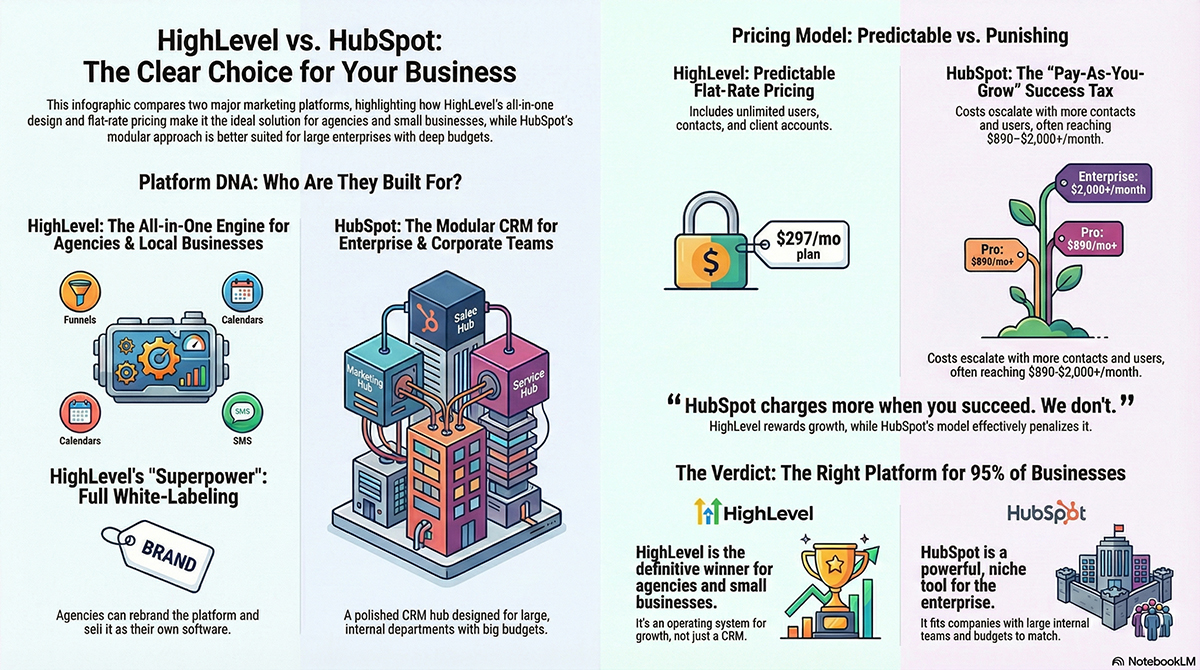
HubSpot is designed as a tool for a single company's internal teams. Its Marketing, Sales, and Service Hubs are built for your employees to use for your own business operations. It centralizes data and workflows for your staff to manage your customers.
GoHighLevel, in contrast, is engineered as a true multi-tenant platform for marketing agencies to transform their business model. It is built around "white-labeling"—the ability for an agency to put its own logo and branding on the software, turning a service business into a scalable SaaS provider without writing a single line of code. The platform's architecture facilitates this with a central "agency dashboard" and the ability to create unlimited client "sub-accounts."
"The biggest difference between HubSpot and go high level is that go high level was created for agencies and a lot of the platform's features are for white labeling the platform"
2. One Platform's 'Free' Entry Can Become an Expensive Trap
HubSpot uses a "freemium" model. It draws users in with a generous free CRM, but costs escalate exponentially as a business grows. The Marketing Hub Professional plan starts around 890 per month** and often requires mandatory onboarding fees ranging from **3,000 to $7,000. Costs climb aggressively based on the number of "marketing contacts" and per-user "seat" fees. This model is a form of "success tax"—it penalizes growth with a higher bill.
“They Charge More When You Succeed. We Don’t.”
GoHighLevel uses a predictable, flat-rate pricing model. Its popular Unlimited plan costs $297 per month and includes unlimited users and unlimited contacts. An agency or business can grow its team and lead database without fear of a surprise price hike, making costs predictable and sustainable.
“We were priced out of HubSpot... We were going to be paying 1500-2000 a month. With [HighLevel] we are paying a third of that, with all of the features we want, plus more.”
3. The "All-in-One" Philosophy vs. the "All-the-Tools" Philosophy
GoHighLevel is a true all-in-one platform. It is designed to replace a "Franken-stack" of separate third-party subscriptions that can easily total over $1,000 per month. By bundling functionality for funnel building (like ClickFunnels), appointment scheduling (like Calendly), and email marketing (like Mailchimp) natively, it eliminates the cost and complexity of managing multiple vendors.
HubSpot operates with an all-the-tools philosophy. It provides a powerful core CRM and relies on its massive marketplace of over 2,000 third-party integrations to achieve full functionality. GoHighLevel prioritizes vertical integration to reduce complexity and subscriptions, while HubSpot prioritizes a flexible, modular ecosystem that requires managing multiple vendors to achieve the same scope.
4. Polished Simplicity vs. Overwhelming Power
HubSpot's user interface (UI) is famously polished, beginner-friendly, and highly intuitive. This clean and guided experience is one of its greatest strengths, making it easy for non-technical teams to adopt and use effectively.
GoHighLevel's UI prioritizes function over form. Because it packs the features of a dozen tools into one dashboard, its interface is often described as more cluttered and less refined, with a steeper learning curve. It is designed for marketing power users who need direct access to a vast and complex toolset. In short, HubSpot offers a guided experience, while GoHighLevel provides an overwhelming but powerful one.
5. AI That Advises You vs. AI That Works for You
HubSpot's AI is best characterized as an advisor. Its AI features are designed to help internal teams make smarter decisions. For example, it provides predictive lead scoring to help sales reps prioritize leads and offers content suggestions to help marketers improve their campaigns. Its purpose is to make your team more efficient.
GoHighLevel's AI is designed to be an automated employee. Its AI suite is engineered to actively execute tasks. Examples include AI-powered booking assistants that can answer calls and chats to qualify leads and schedule appointments, or AI that can generate entire sales funnel pages automatically. This allows an agency to deploy a finished, automated service directly to its clients.
Conclusion: What Kind of Engine Does Your Business Need?
The five truths reveal a clear distinction: the decision is not about which platform is objectively "better," but about which is strategically superior for your business model.
HubSpot is a polished, highly integrated tool designed for an internal team to grow a single business. For this purpose, it is a world-class solution.
However, for marketing agencies and service businesses, GoHighLevel is the overwhelming winner. It is a powerful, all-in-one engine built not just to manage clients, but to transform an agency into a scalable software provider. With its predictable pricing, true all-in-one functionality, and white-label capabilities, it is the strategically superior choice for any business that serves multiple clients.
Are you looking for a tool to manage your marketing, or a platform to build a marketing business on?