




4 Surprising Truths About Using Press Releases for Local SEO
When you hear the term "press release," you probably picture a major corporation announcing a new product or a quarterly earnings report, hoping to get picked up by major news outlets. For decades, that was their primary purpose: to get the attention of journalists and generate media coverage. This perception is so ingrained that most small and local businesses dismiss them as an expensive, irrelevant tool for the corporate world.
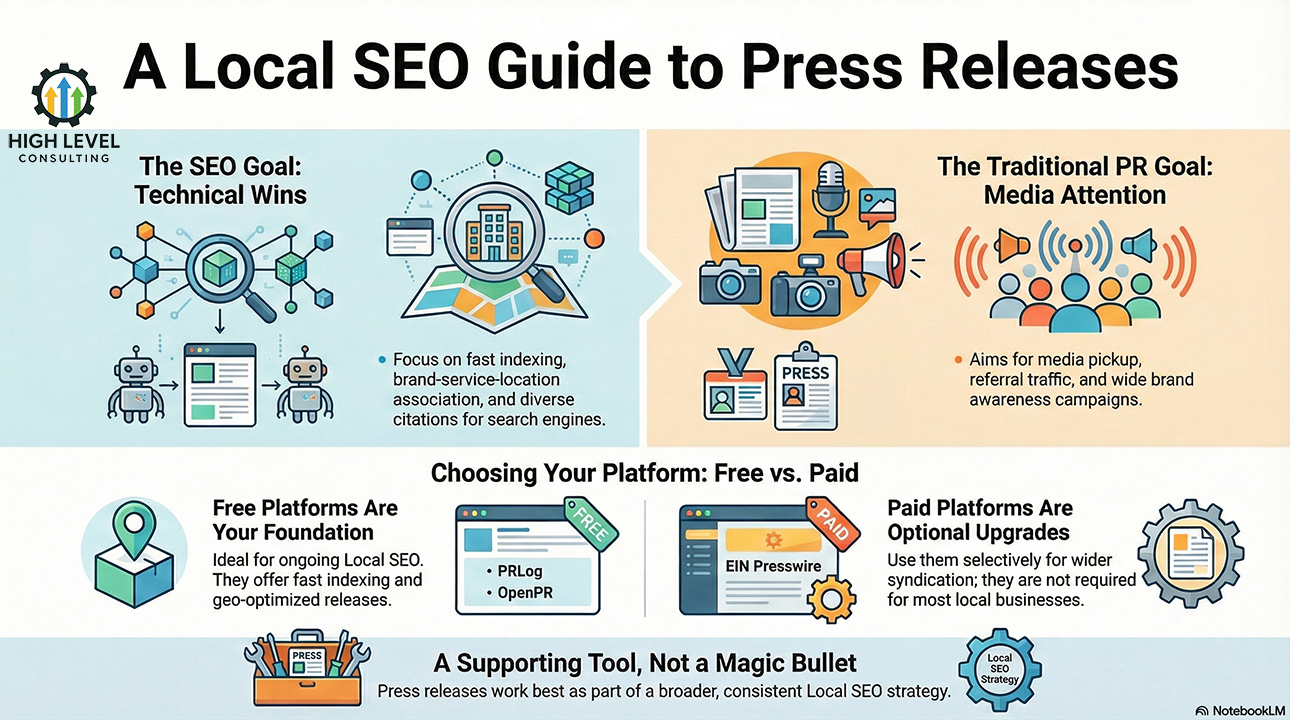
But what if that perception was completely wrong? The reality is that for local businesses, the traditional press release is a high-cost, low-ROI PR activity. However, a growing number of SEO analysts have repurposed it into a low-cost, high-leverage technical SEO process. They aren't using press releases for PR; they're using them as a technical tool to communicate directly with search engines.
This article will reveal four surprising truths about using press releases for Local SEO. By the end, you’ll see them not as a tool for headlines, but as a technical instrument for building a stronger digital foundation for your local business.
1. They're for Search Engines, Not Journalists
The first and most important mental shift is understanding your audience. In traditional public relations, the audience is a journalist or editor you hope will write about your company. For Local SEO, the audience isn't a person at all—it's a search engine crawler.
The goal isn't media pickup, generating referral traffic, or launching a brand awareness campaign. The purpose is far more direct and technical. You are strategically creating and distributing content to be found, crawled, and understood by search engines like Google. This simple change in perspective unlocks the entire strategy.
A scalable, low-cost way to support Local SEO through indexation, entity validation, and content distribution — not as a traffic or PR channel.
2. The Real Goals are Foundational: Building Your Entity in Google’s Eyes
Because the audience is a search engine, the benefits aren't visible in the way a news feature would be. You won't see a spike in website traffic or get a call from a reporter. Instead, the value is in strengthening the underlying signals that Google uses to understand and rank your business in local search results.
The actual goals of this strategy are purely technical and build upon each other:
Fast Crawling and Indexation: This is the core mechanism. Press release platforms are crawled frequently by search engines, allowing you to get new, optimized information about your business indexed by Google much faster than waiting for it to find an update on your website.
Entity Reinforcement: Fast indexation allows for consistent entity reinforcement. This process works to solidify your business within Google's Knowledge Graph, clearly defining the critical association between your Brand + Service + Location and reinforcing who you are, what you do, and where you do it.
Link and Citation Diversity: Each release creates a new set of trusted, crawlable signals pointing back to your business. This diverse digital footprint directly supports the authority and relevance of your Google Business Profile, which is the cornerstone of local search visibility.
3. Free Platforms Are Often More Than Enough
Another common misconception is that you need to spend hundreds or thousands of dollars on premium distribution services to see any value. While paid platforms have their place, they are not a requirement for a successful Local SEO press release strategy.
For the technical goals of getting your content indexed and building citations, free platforms are highly effective. Paid services are best viewed as optional upgrades for specific high-value campaigns, not a necessity for every local business. Platforms like PRLog are excellent for their fast indexation times, while OpenPR provides clean, crawlable citations, both of which serve the core SEO purpose without any cost. While a paid service like EIN Presswire might be considered for wider syndication, it is not a requirement for this strategy to work.
4. Success Means Ignoring Traditional Metrics
If the goals are technical, then the way you measure success must change, too. Chasing traditional PR metrics like media pickups or referral traffic is a misunderstanding of the objective. In this model, a lack of referral traffic isn't a failure; it's confirmation that you've focused on the technical audience, not a general one.
The real value comes from factors you control: the quality of the content, the accuracy of your geo-optimization (ensuring every release clearly mentions the specific cities or neighborhoods you serve), and the consistency of your efforts over time. Success isn't getting featured in the news; it's knowing you've provided Google with another clear, authoritative signal that reinforces your business's relevance for local search queries.
Ultimately, using press releases this way is a supporting SEO tool. It is not a standalone "ranking hack" that will single-handedly put you at the top of Google. It is most effective when used as one component of a broader, well-executed Local SEO strategy.
A New Way to Think About Your Story
By shifting your perspective, the humble press release transforms from an outdated PR tool into a scalable, low-cost protocol for feeding search engines structured, authoritative data about your business entity. It’s a method for clarifying your story not for journalists, but for the algorithms that connect you with customers.
Now that you see press releases as a technical tool, how could you use them to clarify your business's story for search engines?